
Voices of the Valley - May 2026
- May 12
- 9 min read

From the Venerable Master (May 2026)
Royal Influence on the Swedish Rite
The Swedish Rite boasts a unique and enduring historical connection with the Swedish Monarchy, a relationship that has significantly shaped its identity and prestige.
A. Historical Connection with the Swedish Monarchy
Duke Carl, who later became King Charles XIII and reigned from 1809 to 1818, played a crucial role in finalizing the structure and rituals of the Swedish Rite. Even prior to his ascension to the throne, his deep involvement and patronage were instrumental in the Rite’s development.
Earlier, King Gustavus III, who lived from 1746 to 1792, harbored an ambition to weaken the power of the old nobility and potentially envisioned the Masonic Order as a new form of meritocracy, further intertwining the Crown with the evolving Rite.
However, the most significant aspect of this royal connection is the tradition established by King Charles XIII. Since his reign, all Swedish Kings have served as Grand Masters of Swedish Freemasonry, with the notable exception of the current monarch, King Carl XVI Gustav, who serves as the Protector of the Swedish Order.
This unbroken lineage of royal leadership underscores the profound and unique relationship between the Swedish Rite and the Swedish Crown.
B. Establishment and Nature of the Order of Charles XIII, 1811
The most tangible manifestation of this royal influence is the establishment of the Order of Charles XIII in 1811 by Charles XIII himself.
This Masonic Order, bearing the King’s name, was created as the “most conspicuous mark of our confidence” to be conferred upon the principal dignitaries of the Swedish Masonic society.
It is a real honorary Chivalric Order of the Crown, signifying the highest dignity attainable within the Swedish Masonic system. Membership in the Order is strictly limited to twenty-seven Civil Knights and three Ecclesiastical Knights, totaling thirty members, excluding royal princes.
Admission to the Order requires candidates to have completed at least thirty-six years of age and to have reached the X Degree of the Swedish Rite, highlighting its position as the culmination of the progressive system.
The King of the Swedes and his successors serve as the Grand Masters of this Order, with the heir to the throne holding the general direction thereof.
The purpose of the Order, as outlined in the Manifesto and Statutes, includes encouraging subjects to practice beneficence and perpetuating the remembrance of the devotion of the Swedish Masonic society to the King.
The insignia of the Order is a distinctive ruby-colored cross, with specific symbolic elements on each side, surmounted by a golden crown and suspended from a red ribbon.
San Jose Lodge of Perfection David Kampschafer, 32° KCCH 2024 Venerable Master

From the Wise Master
(May 2026)
Chapter of Rose Croix
In the Ancient Accepted Scottish Rite, the Chapter of Rose Croix is a subordinate body that confers several degrees focused on religious, philosophical, and ethical themes. It is often referred to as the “spiritual center” of the Scottish Rite.
Degrees Conferred
The specific degrees governed by a Chapter of Rose Croix vary by jurisdiction.
In the Southern Jurisdiction, the Chapter of Rose Croix confers the 15th through 18th Degrees:
15°: Knight of the East, of the Sword, or of the Eagle
16°: Prince of Jerusalem
17°: Knight of the East and West
18°: Knight of the Rose Croix
Key Themes and Lessons
The Chapter of Rose Croix is known for its “Philosophical” or “Doctrinal” degrees.
Universal Ethics: While many of the degrees use a Christian historical backdrop, they are interpreted universally to include men of all faiths who believe in a Supreme Being.
Virtues: The lessons emphasize the three cardinal virtues of Faith, Hope, and Charity.
18th Degree, Knight of Rose Croix: This is the pinnacle of the Chapter. It teaches the “New Law of Love,” emphasizing tolerance, virtue over vice, and the belief that life’s strength comes from God.
Symbolism: The “Rose on the Cross,” or Rose Croix, represents the “rose cross” of the Rosicrucians, symbolizing the beauty and glory of the New Law incarnate in the lives of men.
San Jose Chapter of Rose Croix Frank Fitzgerald, 32° KCCH 2024 Wise Master
From the Commander of Kadosh (May 2026)
Masonic Chivalry Reconsidered: A Quiet Obligation
Occasionally we hear the word chivalry and perhaps picture something distant and ancient, a word no longer applicable to our modern times. Perhaps we imagine knights clad in gleaming armor and regal banners, but still an ancient world far removed from our own. It can feel to many like a concept relegated more to history books than a guide to our daily lives, especially now, when we are blanketed by our coveted innovations and profit-hungry technologies.
Yet, within the Scottish Rite, particularly in the Council of Kadosh and its chivalric emphasis, the idea of chivalry persists. Not as pageantry, but as a quiet stream that runs through the river of our degrees and eventually into the pool of our own conduct.
The knight of old was bound by a code, akin to our own obligations. Not a perfect code, and certainly not always perfectly lived, but a code nonetheless. Honor, self-restraint, loyalty, and a sense of duty shaped the good knight’s actions and demeanor with others. While the outward forms of those attributes have evolved, the underlying questions they pose to us remain familiar.
What does it mean for a Scottish Rite brother to act with honor when no one is watching? How do we, as brothers and gentlemen, respond when our patience is tested, or when our judgment or skills are questioned? Where does restraint fit in a world that often rewards immediacy and instant gratification?
These are not uniquely Masonic questions, but fortunately, they are questions that our institution encourages us to consider more deliberately. Albert Pike, in Morals and Dogma, reflected that “the true Mason labors for the benefit of those who are to come after him,” reminding us that our work is not merely short term, but enduring. That concept resonates closely with the older ideals of chivalry, where duty extended beyond selfish interests.
It is easy to link chivalric manners with highly visible acts. In practice, however, one may find them more often in smaller, less obvious decisions: a measured response instead of a quick and often angry reaction, or a willingness to listen rather than to correct. It is a quiet consistency in how we carry ourselves, regardless of the setting or who is watching.
There is nothing particularly dramatic about these choices. In fact, they may go entirely unnoticed, but their impact accumulates. Our own RiteCare philanthropy helps youth with speech issues every week, and the impact on the student, their teachers, and also on us demonstrates that our efforts can have a positive effect long after the student moves forward or we move on.
Pike also suggests that Masonry concerns itself with the internal building of character rather than its outward display. If that is so, then whatever we mean by chivalry must also still live within our souls to some degree, through our ordinary deeds that help others, in the unobserved funding of philanthropic projects, and in the daily altruistic habits we display toward others.
If the Council of Kadosh preserves anything of that knightly tradition, it may be this: a reminder that the work is ongoing, and often internal. The symbols and language of the degrees point outward, but their application is meant for the brother’s inner self. Freemasonry does not ask us to become something different overnight, and certainly not to become perfect. Rather, it offers a framework, a set of guiding ideas and examples, that we may revisit and reflect upon again and again, as circumstances require, so that our internal moral compasses continue pointing toward the tenets of our institution.
How often have we each heard a Past Master quip that while witnessing degree work, they always find some tidbit, some gold nugget they had not caught in all their previous recitations of the same degree?
Chivalry is less about revival and more about recognition. It is not something newly adopted, but something gradually understood with time and application. As we transform ourselves through our graduated degrees, those chivalric-like understandings manifest in our becoming better men. Yet each of us will interpret that recognition of chivalric principles differently.
For some, it may appear in honing leadership skills. For others, it may appear in being more patient with a new Mason eager to learn the memorized craft, but not quite having the knack that only experience will sharpen. For some, it may mean becoming that reliable asset, the brother who, when there is a chore to complete or a chair to fill, is recognized as a “can do” Mason.
Given the diversity in our brothers’ ages, religious and worldviews, physical abilities, and demeanors within our institution, chivalry, in the sense of fraternity, charity, and honesty, is manifested in our degrees and Masonic manners. We then carry those virtues into the world as Scottish Rite Masons.
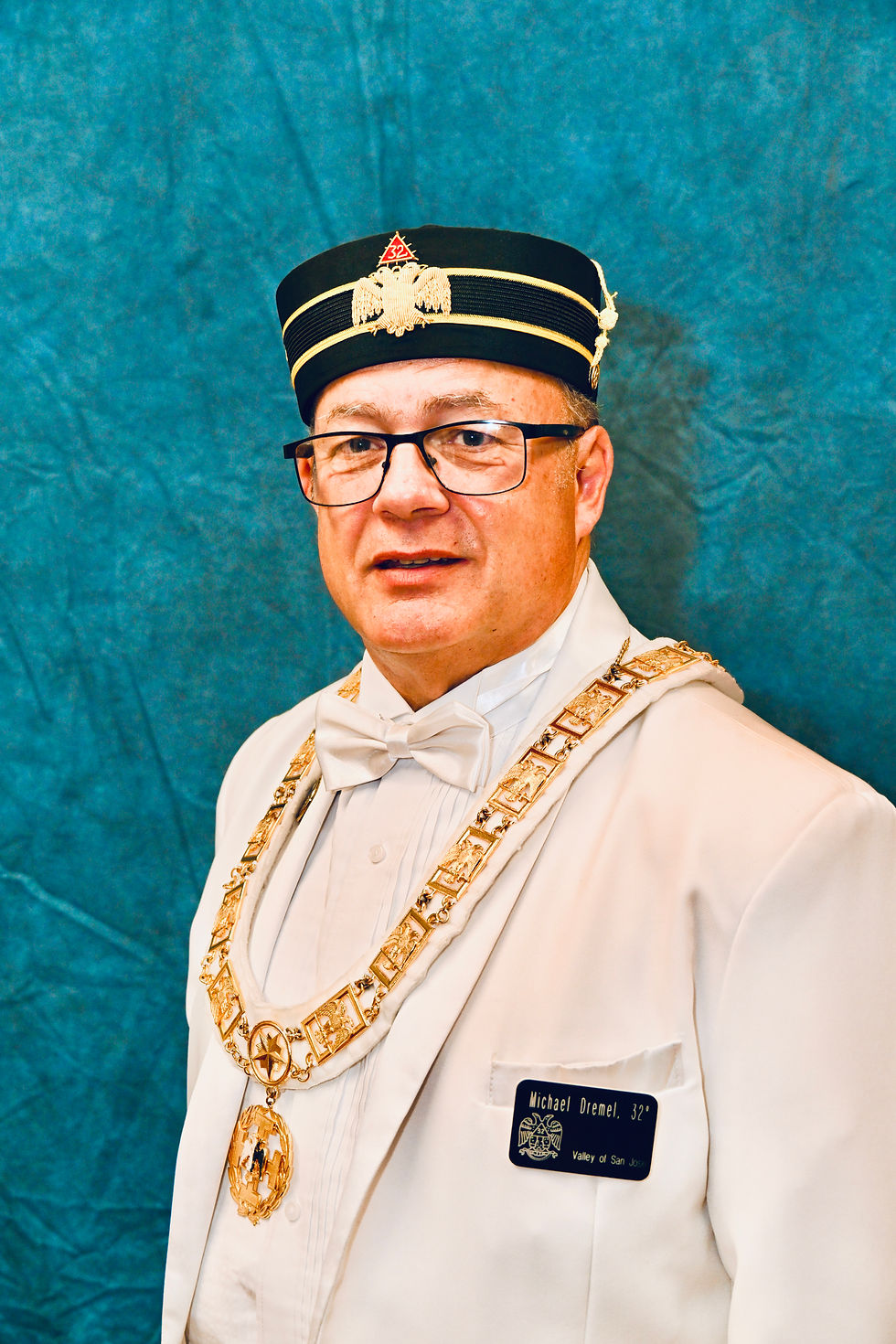
San Jose Council of Kadosh Michael Dremel, 32° 2024 Commander of Kadosh

From the Master of Kadosh (May 2026)
Greetings,
I would like to thank all who attended our Maundy Thursday Ceremony of Remembrance, and especially our speaker, Bro. Kevin Pasquinelli, 32°, and cast: Hon. Naresh Rampershad, 32°, Sound; Ill. Bud Ramsey, 33°, Secretary; and Hon. Joe Campbell, 32°, PR.
We have a very special day this month which started out with the name of Decoration Day, beginning after the Civil War in 1868. This holiday was started by the Grand Army of the Republic, a fraternal group of veteran Union soldiers from Illinois. They would decorate the graves of fallen Union soldiers from the Civil War with flowers in remembrance of their service to their nation.
By 1890, nearly every Northern state had adopted the holiday, but eventually the First and Second World Wars changed the character of the holiday to include memorializing the fallen from those wars as well. Due to the rivaling observance dates between Union and Confederate groups, Congress established Memorial Day in 1971 to occur on the last Monday in May. This act united the Union and Confederate groups by honoring both sides of fallen soldiers on the same day, and helped to ease the last remaining scars of the conflict.
This should not be confused with Veterans Day, however, which celebrates United States military veterans.
Memorial Day has its own unique flag ceremony. We will notice the flag of the United States moving several times throughout the day. In the morning, Old Glory will be quickly hoisted to full mast, then ceremoniously lowered to half mast until noon, when it will be raised back to full mast for the remainder of the day.
The journey up and down the flagpole, and the symbolic meaning of the flag’s movement, is one of beauty. While at half mast, it reminds us of the more than one million soldiers who have given their lives for our country. When the flag is raised to full mast at noon, it symbolizes these soldiers’ memories being raised by the living, acknowledging that their efforts were not in vain, and allowing us to rise up and fight to secure our liberties in their memory and by their example.
Remembering the service of these soldiers to their nation, we ask ourselves how we can be of service to others. Within our Scottish Rite Valley in particular, we have one program that does so much for our community: the RiteCare Clinic.
This program has helped many children resolve various speech difficulties through the copious hours of work by licensed clinicians with the children. This is a service funded by our Scottish Rite Valley alone. We had donations of about $3,000 from our membership for the clinic last year, and we are very thankful for those. I am certain we will far surpass that amount this year.
We also should think outside the box, as monetary donations are not always possible, nor are they always the best or most appropriate act of charity. Take a lesson from our Almoner, Brother Kaleo Gange. He has been cutting hair for $25 and donating 100% of the proceeds, totaling roughly $3,000.
Well done, Brother, and keep up the “Cuts for Kids” you have created. Your service to the community, by combining your profession with charity, is an example for us all.
San Jose Consistory Brandon Dueñas, 32° KCCH 2025 Venerable Master of Kadosh

From the Chief Knight
(May 2026)
Greetings My Brothers,
At our March 15 meeting, the Highland Games Committee gave us an update on this event, which we are all looking forward to attending. I invite you all to reserve Labor Day Weekend, September 5 and 6, for this event.
It is probably this area’s largest non-Masonic Masonic event. We are expecting Burlingame, Sacramento, San Francisco, Santa Rosa, and Stockton Scottish Rite KSA to join us.
After the meeting, we elevated Brother Phil Bates to Knight of the First Order. Congratulations, Sir Knight. We then had a BBQ and smoker with about 25 Brothers in attendance.
Next month, I will report on our April 19 meeting. Our next regularly scheduled meeting will be on May 17 at High Twelve. All 29th Degree or higher Brothers are invited to join us for some good fellowship.
We meet on the third Sunday of the month, downstairs in the classroom. Since the June meeting falls on Father’s Day, however, we will meet on the following Sunday, June 28.
If you have any questions about KSA, please feel free to contact me or any of my Officers. We look forward to the privilege of serving our Brethren. San Jose Knights of St. Andrew Alan Porjesz, 32°
2026 Chief Knight, KSA
The Knights of Saint Andrew 2026 Officers
Chief Knight | Bro. Alan Porjesz 32º |
First Knight | Bro. Mike Lammer 32º |
Knight of the Watch | Bro. Ben Shuford 32º, PCK |
Secretary | Bro. Tim Lynch 32º |
Monk Knight | Bro. Chris Boyes 32º |
Sentinel | Bro. Maximo Mora 32º |
