
Voices of the Valley - April 2026

From the Venerable Master (April 2026)
The Swedish Rite (Svenska Riten)
Part 2
The Swedish Order is organized into a hierarchical structure comprising St. John’s Lodges (Degrees I-III), St. Andrew’s Lodges (Degrees IV-VI), and Chapters (Degrees VII-X), along with research and stewards’ lodges. Notably, the United Grand Lodge of England recognizes the Swedish Order of Freemasons as a regular Masonic jurisdiction, underscoring its adherence to fundamental Masonic principles.
Structure of the Swedish Rite
The Swedish Rite presents a progressive, continuous, and homogeneous system encompassing eleven degrees, a significantly more extensive structure than the traditional three Craft Lodge degrees prevalent in many other Masonic traditions. These eleven degrees are organized into three distinct divisions, as follows:
A. St. John’s Degrees, or the Craft Degrees (I-III)
This first division aligns with the foundational degrees of Freemasonry recognized globally.
1st Degree, Apprentice
The initial stage of Masonic initiation.
2nd Degree, Fellow Craft
A period of further learning and progression.
3rd Degree, Master Mason
The completion of the Craft degrees, signifying full membership.
These degrees in the Swedish Rite are closely related to the rituals found in traditional Craft Lodges, and the typical timeframe for a brother to be raised a Master Mason within the Swedish system is two to three years.
B. St. Andrew’s (Scottish) Degrees (IV-VI)
Building upon the foundation of the Craft degrees, this division introduces uniquely Swedish perspectives.
4th-5th Degrees, Very Worshipful Apprentice and Fellow of St. Andrew
These are often conferred together, representing a progression beyond the Master Mason degree with specific teachings related to the patron saint of Scotland and of this division.
6th Degree, Illustrious Scottish Master of St. Andrew
This degree elaborates further on the themes introduced in the previous St. Andrew’s degrees.
These degrees follow the St. John’s degrees in much the same way as the Mark Master Mason and Royal Arch in other jurisdictions. They possess their own distinct rituals and require specific lodge room setups. A brother can typically attain the sixth degree within four to six years of his initial entry.
C. Chapter Degrees (VII-X)
This division represents a significant progression into the higher degrees of the Swedish Rite, delving into more profound philosophical and spiritual concepts.
7th Degree, Very Illustrious Brother
Also known historically as Knight of the East.
8th Degree, Most Illustrious Brother
Historically known as Knight of the West.
9th Degree, Enlightened Brother of St. John’s Lodge
Also referred to as Confident of St. Andrew or Perfect Templar.
10th Degree, Very Enlightened Brother of St. Andrew’s Lodge
Also known as Knight Companion of the Red Cross.
These degrees share some thematic connections with rituals found in Great Priories and Supreme Councils in other rites, but they possess their own unique rituals and are conducted in specifically designated lodge rooms.
Reaching the tenth degree in the Swedish Rite is a slow and continuous process, often taking twelve to twenty years after a brother’s initial entry as an Apprentice.
D. XI Degree, Most Enlightened Brother, Knight Commanders of the Red Cross
This final and highest degree within the active structure of the Swedish Rite is almost exclusively reserved for officers in the Grand Lodge and Provincial Grand Masters. It represents a level of leadership and service within the Swedish Masonic Order rather than a degree attainable by all members.
The progression through these eleven degrees is intentionally slow and continuous, particularly in the higher degrees, emphasizing a deep and gradual assimilation of the Rite’s teachings.
A unique characteristic of the Swedish Rite is the use of different lodge rooms specifically designed for each division of degrees, enhancing the ritualistic experience and underscoring the distinct nature of each stage of Masonic development.
Furthermore, the Swedish Rite employs a unique way of working based on the lodge room, the ritual, and an individual examination in each degree, ensuring personal engagement with the Masonic lessons.
A defining feature of the Swedish Rite is its explicit Christian foundation. The Rite is expressly stated to be “based on the Christian faith” and “strictly Christian in inspiration.”
Consequently, membership requires all candidates to be men “with a Christian spirit,” and only Christians are admitted into the Swedish Rite. The meetings of the Swedish Order of Freemasons are conducted “in a Christian spirit,” and the journey through the degrees is intended to deepen a brother’s understanding of Christian principles and foster a relationship with fellow members grounded in a shared faith and belief in God.
The Swedish Rite also places itself under the patronage of two Apostles, St. Andrew and St. John, further emphasizing its Christian identity.
San Jose Lodge of Perfection David Kampschafer, 32° KCCH 2024 Venerable Master

From the Wise Master
(April 2026)
Vernal Equinox Observance
The Scottish Rite Chapter of Rose Croix, encompassing the 17th and 18th degrees, conventionally holds its mandatory Ceremony of Remembrance and Renewal near the vernal equinox, around March 21, aligning with the season’s rebirth and the 18th degree teachings of love and immortality.
Key Connections to the Vernal Equinox
This astronomical alignment, where day and night are of equal length, serves as a primary symbol of balance between light and darkness, and of the triumph of spiritual light over the darkness of winter.
Spiritual Significance
Symbolic Rebirth
As the vernal equinox marks nature’s rebirth in the Northern Hemisphere, the Rose Croix Chapter observes this time as a reminder for members to renew their spiritual and moral lives. Just as nature awakens, the equinox represents the rebirth and renewal of the human soul. It is viewed as a time for regeneration and for beginning a new life aligned with divine nature.
The Rose and the Cross
The Rose Croix symbol itself carries seasonal meaning. The cross can represent the physical body or material world, while the blossoming rose represents the unfolding of consciousness.
Balance
The equal duration of day and night reflects a middle point, or harmony, that practitioners strive to achieve in their inner lives.
Traditions and Rituals
Masonic Rose Croix
In the Scottish Rite, the 18th Degree, Knight Rose Croix, traditionally observes ceremonies around the vernal equinox, such as Maundy Thursday, focusing on renewal and the New Commandment of love.
Rosicrucian New Year
Orders such as the Ancient and Mystical Order Rosae Crucis, or AMORC, hold special convocations on or near March 21 to mark the beginning of their spiritual calendar.
Common Ritual Acts
Planting Seeds
Metaphorically setting new intentions or goals for the coming cycle.
Spring Cleaning
Purifying one’s physical and mental space to welcome fresh energy.
Lighting Candles
Symbolic of the returning warmth and the relighting of the lights.
Closing Thought
Join me in the transition into the spring season, and enjoy the longer light of the days ahead.
San Jose Chapter of Rose Croix Frank Fitzgerald, 32° KCCH 2024 Wise Master
From the Commander of Kadosh (April 2026)
The Modern Knight
Chivalry and Liberty in the Council of Kadosh
Throughout history, the image of the knight has captured the imagination of generations. In the Middle Ages, knights swore oaths to maintain ideals of honor, courage, and service to the crown. They pledged themselves to defend the weak, uphold justice, and protect the innocent.
While the age of armored warriors has long since passed, the ideals of chivalry have not. Instead, they have evolved, and in many ways they live on within the teachings of Freemasonry, and most especially in our Scottish Rite.
Within the Council of Kadosh, we encounter a powerful reinterpretation of the knightly idea. Its rituals invite us to reflect on what it means to be a knight in the modern world. Our battles are no longer fought with swords, but with spoken truth and displayed character. Our armor is not steel, but integrity. Our mission is not conquest, but the defense of truth, justice, and liberty.
The chivalric symbolism of the Scottish Rite is often associated with the legendary traditions of the medieval Knights Templar. While Freemasonry is not historically descended from those orders, the Templar story captured the imagination of Enlightenment-era Masons who admired their reputation for courage and devotion to principle. In the Scottish Rite, this symbolism was transformed into a philosophical lesson. The knight of today is not defined by lineage or the sword he bears, but by his commitment to his obligations as a Freemason. The modern Knight of Kadosh therefore inherits not the battles of medieval crusaders, but the moral responsibility to defend liberty and human dignity.
One of the more profound themes of the chivalric tradition within the Scottish Rite is the defense of liberty of conscience. The knights of old protected pilgrims and travelers’ caravans from physical harm. The modern Knight of Kadosh protects something equally precious, the freedom of every individual to think, to believe, and to worship according to the dictates of his own conscience.
Indeed, the history of our fraternity is closely connected to the advancement of human liberty. Many of the leaders who helped shape our country’s democratic ideals were themselves Freemasons, George Washington and Benjamin Franklin being two examples. These men understood that the true strength of a nascent nation rests not in tyrannical power, but in the liberty and dignity of its citizens.
Yet the Council of Kadosh teaches us that the knight’s duty extends beyond public life. The true battlefield of the modern knight is often within himself. None among us dare say we are perfect in all ways, but our rituals and teachings daily remind us to strive onward, to act with integrity, to remain faithful to truth, and to practice charity toward others as the true test of our character. The Knight of Kadosh is called not only to oppose injustice in society, but also to cultivate virtue within his own heart.
Even the symbolism of the Council reflects this noble calling. The white jackets worn by the officers of the Council of Kadosh symbolize purity of purpose and dedication to high ideals. When we don this garment, we symbolically renew before all of us the ancient vow of chivalry, to stand for truth, to defend liberty, and to serve humanity.
As Albert Pike wrote in Morals and Dogma, “The true Mason is a knight of justice and humanity, armed not with the sword of steel but with the sword of truth.” This reminds us that the chivalric spirit of Freemasonry is not shallow or merely ceremonial. It is a call to live with courage, integrity, and devotion to the welfare of mankind.
The world today still needs knights, not those of old armed with swords, but knights of character and conviction of spirit. The Council of Kadosh reminds us that the true measure of chivalry is not found in titles or regalia, but in the quiet, steadfast commitment to freely give our service and strength to improve the plight of our fellow humankind.
Recall my recent article about our brother John Swett, who became known in the late 1800s as the “Father of Free California Public Education.” His was truly a life of service for the betterment of the citizens of our fair state. Yet we may ask ourselves a thoughtful question: where are the John Swetts of today?
Freemasonry has always encouraged its members to carry Masonic principles into the world beyond the lodge room. Who do you know who is a Freemason and knight within your community, a teacher shaping tomorrow’s workers and leaders, perhaps your own child’s teacher, or a firefighter, police officer, or even a government official? Where are the John Swetts of today?
Granted, some serve quietly, but for Freemasonry to become truly known for our role as knights and men of character, we must become visible in our quest to grow our lodges and make the world a better place.
And so, good knights of the Scottish Rite, we continue the ancient chivalric tradition in a new form, carrying forward the enduring spirit of chivalry into the modern age.
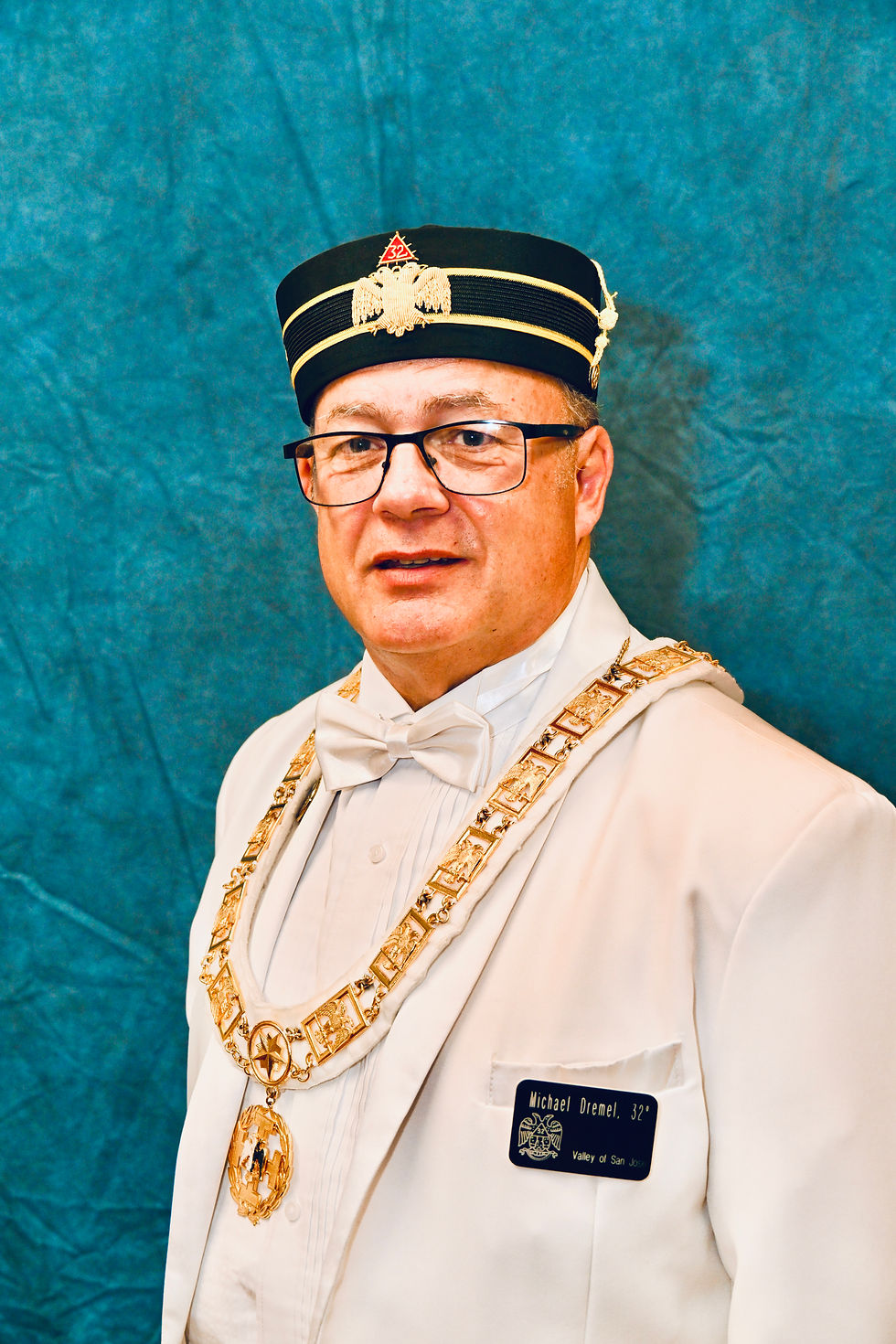
San Jose Council of Kadosh Michael Dremel, 32° 2024 Commander of Kadosh

From the Master of Kadosh (April 2026)
Greetings All, and hoping you are well.
We often hear of the Cedars of Lebanon throughout Masonry, particularly with respect to their use in the construction of the Temple by Solomon and Zerubbabel. There is a grove of cedar trees known as the Cedars of God in the Kadisha Valley near Bsharri, Lebanon. Kadisha, romanized as Quadisha, means holy in Aramaic, and indeed its name is apropos, as this region has sheltered Christian monastic communities for many centuries.
It is thought to contain the remnants of the ancient grove of trees harvested for King David in the construction of his city and the First Temple.[1] Today, the grove spans some 25 acres and contains roughly 375 living trees, two of which are believed to be over 3,000 years old, and ten of which are thought to be over 1,000 years old.
In 1550, Pierre Belon observed about 28 ancient trees, and Leonhard Rauwolf observed only 24 just twenty-five years later in 1575. Jean de Thévenot observed 23 in 1655, and just 20 were counted five years later by Laurent d’Arvieux in 1660. The population remained stable through 1722, when it was observed by Jean de Roque, and fell to just 15 ancient trees by 1738, when it was recorded by Richard Pococke.
Today, through rigorous forestry practices and its protection as a UNESCO World Heritage Site, the Cedars of God have been preserved and are growing and expanding for future generations to enjoy.
Clearly, if something had not been done, these ancient trees would have been lost forever.
In the nineteenth century, Americans began to notice that they too were losing their own forests at an alarming rate as a result of westward expansion and the pursuit of Manifest Destiny. April 29 marks an important day, often passed over, in the conservation of our forests.
J. Sterling Morton and his wife moved from the heavily wooded regions surrounding Detroit to the plains of Nebraska, but they longed for something. He and his fellow pioneers were missing their trees. This desire planted the seeds of an idea, to plant trees, and this idea sprouted and grew. From then on, he wrote magazine articles and inspired his friends and neighbors.
This movement gained momentum, and on January 4, 1872, Morton proposed a day of planting trees at the Nebraska State Board of Agriculture. Arbor Day was born on April 10, 1872, and an estimated one million trees were planted on that first day.
While we may not all be able to plant a tree, if we look past the physical act of planting trees and focus on the symbolic meaning of Morton’s message, it reveals the possibility for all of us to make a change.
All of us can give a small amount of ourselves to invest in the future, to plant our symbolic trees for future generations to enjoy, without the expectation of sheltering under their branches in our own lifetimes. With each action we take, and with the decisions we make for the benefit of our posterity, we are planting seeds that will ensure not only their success, but also the success of those who are yet to pass through our sacred doors.
Let us continue to preserve and honor the past, and also to grow and flourish like the ancient Cedars of God.
“Each generation takes the earth as trustees.”
— J. Sterling Morton
Till next time, God bless.
San Jose Consistory Brandon Dueñas, 32° KCCH 2025 Venerable Master of Kadosh

From the Chief Knight
(April 2026)
Greetings My Brothers,
We have had a busy time since I last communicated with you. Several Brothers have inquired about joining KSA, and we are pleased to welcome Brothers Neal Gassard and Rene Rodrigues to our ranks.
Our March business meeting was short and to the point so that we could move on to the fun part, namely a BBQ. We had about 25 people in attendance, and all had a good time. Part of that good time can be attributed to the Burn Brothers, Angelo Encarnacion and Eddie Hermano. They fired up the grill and cooked a feast of hamburgers, cheeseburgers, and hot dogs.
Thank you to all the Brothers who brought side dishes and beverages. A special thanks also goes to the Brother who brought the spare ribs, they were delicious.
Along with the food came excellent fellowship, with plenty of lively conversation throughout the gathering. The Bad Air Club was in attendance as well. Nobody left hungry, and everyone was in good spirits.
After the meal, we adjourned inside and invested Brother Phil Bates as a Knight of the First Order. Congratulations, Brother Phil. Wear your Black Hackle proudly.
Our next meeting will be May 17th at High Twelve, downstairs in the conference room. All 32nd Degree Scottish Rite Masons are invited to join us as we prepare for our biggest social event of the year, The Highland Games in Pleasanton, held during Labor Day Weekend.
I have it from a reliable source that we will be returning to our old location by the Bagpipe Competition.
If you have any interest in joining us, please contact either Brother Tim Lynch, our Secretary, or myself.
Kilt not required, but fun to wear. San Jose Knights of St. Andrew Alan Porjesz, 32°
2026 Chief Knight, KSA
The Knights of Saint Andrew 2026 Officers
Chief Knight | Bro. Alan Porjesz 32º |
First Knight | Bro. Mike Lammer 32º |
Knight of the Watch | Bro. Ben Shuford 32º, PCK |
Secretary | Bro. Tim Lynch 32º |
Monk Knight | Bro. Chris Boyes 32º |
Sentinel | Bro. Maximo Mora 32º |
