
Voices of the Valley - March 2026
- Mar 17
- 9 min read
Updated: Mar 26

From the Venerable Master (March 2026)
The Swedish Rite (Svenska Riten)
Part I
For Freemasons worldwide, the fraternity presents a rich tapestry of diverse rites and traditions, each offering a unique pathway to Masonic light and understanding, such as York Rite Masonry and Scottish Masonry, for example.
Among these, the Swedish Rite stands out as a distinct and historically significant system, primarily prevalent in the Nordic countries of Sweden, Denmark, Norway, Iceland, and Finland, with a limited presence in parts of Germany and Spain.
Introduction
Freemasonry, as a global fraternity, embraces a multitude of rites, each with its own rituals, symbolism, and historical trajectory.
These diverse systems, while they share core tenets of brotherly love, relief, and truth, offer varied approaches to Masonic education and fellowship.
The Swedish Rite (Svenska Riten) represents one such distinct tradition, characterized by its eleven progressive degrees, its explicit Christian foundation, its unique ritualistic practices, and its close historical and contemporary ties to the Swedish Crown.
Predominantly practiced in the Nordic region, its specific characteristics often remain less familiar to Freemasons from other jurisdictions, such as those following the Anglo-American or Continental traditions.
Freemasonry was first introduced to Sweden in 1735, not through the influence of the Grand Lodge of England, as was the case in many other European countries, but through French origins.
Count Axel Wrede-Sparre (1708-1772), having received the three Craft degrees in France, founded the first lodge in Stockholm in 1735. This initial phase firmly established a French Masonic lineage in Sweden.
Further solidifying this connection, Baron Carl Frederik Scheffer (1715-1786) returned to Sweden in 1738 after a period in France, carrying a letter from Lord Derwentwater, then Grand Master of the Grand Lodge of France.
This letter granted Scheffer permission to establish and oversee lodges under the jurisdiction of the Grand Lodge of France, pending the election of a Swedish Grand Master. He established the first Scottish Chapter in Stockholm in 1743, introducing early French higher degrees.
Despite a brief ban in 1738 by King Frederick I, Freemasonry soon regained favor. The culmination of this early French influence was the creation of the Grand Lodge of Sweden in 1761, which received its patents from the Grand Lodge of France and adopted rituals of French origin.
During this initial period, the Swedish Masonic system likely consisted of the three Craft degrees and some of the early higher degrees of French origin that were becoming prevalent in Europe at the time.
The Swedish Rite reached its current and definitive structure with the establishment of the Order of Charles XIII in 1811.
This knightly order, personally founded by King Charles XIII, became the highest distinction within the Swedish Masonic system. Membership in this prestigious order was limited to members who had reached the X degree of the Swedish Rite, signifying the culmination of the progressive degree system.
The creation of this order not only finalized the eleven-degree structure but also cemented the close relationship between Swedish Freemasonry and the Royal House.
Today, the Swedish Order of Freemasons (Svenska Frimurare Orden) stands as the constituted body responsible for all Swedish Rite Freemasonry in Sweden and the western parts of Finland.
With a history spanning nearly 300 years and a current membership of approximately 14,000 in Sweden and 1,300 in Finland, it represents one of the oldest and most established fraternal orders in the region.
San Jose Lodge of Perfection David Kampschafer, 32° KCCH 2024 Venerable Master

From the Wise Master
(March 2026)
My Brethren, please mark your calendars.
Thursday, April 2, 2026 is our Maundy Thursday Ceremony.
Maundy Thursday holds significant meaning in the Masonic Ancient and Accepted Scottish Rite. It is observed as a day of reflection and remembrance, particularly within the context of the Eighteenth Degree, known as the Knight Rose Croix. This observance commemorates the Last Supper of Jesus Christ and emphasizes themes of service, humility, and sacrifice.
The Knights of Rose Croix observe Maundy Thursday with a solemn, often public, ceremony known as the Extinguishing of the Lights or the Feast of the Paschal Lamb. It commemorates the Last Supper and the death of Christ, focusing on themes of love, immortality, and remembrance of departed brethren. The ceremony draws parallels to Christian Holy Week observances while maintaining Masonic symbolism.
Symbolic Meaning
The extinguishing of lights represents darkness before resurrection, symbolizing trials and spiritual renewal. According to Scottish Rite tradition, this ceremony marks the moment when “True Light dispelled the Darkness and the New Love began to rule upon the earth.” The observance reinforces core Masonic values of brotherly love, personal sacrifice for humanity’s betterment, and spiritual reflection during Holy Week, concluding with the relighting ceremony on Easter morning.
Historical Context
The term “Maundy” is derived from the Latin word mandatum, meaning “commandment,” which refers to Jesus’ command to love one another as He loved His disciples. This day was traditionally marked by the washing of feet, symbolizing humility and service to others.
I invite you to attend this celebration.
San Jose Chapter of Rose Croix Frank Fitzgerald, 32° KCCH 2024 Wise Master
From the Commander of Kadosh (March 2026)
John Swett: A Mason on a Mission Condensed Summary
John Swett (1830-1913), widely recognized as the “Father of the California Public School System,” played a transformative role in establishing free, universal, and state-supported public education in California during the mid-19th century. Serving as California’s fourth Superintendent of Public Instruction from 1863 to 1867, Swett implemented sweeping reforms that laid the institutional foundation for the state’s modern public school system. His work was shaped not only by the national common school movement, but also by his deep commitment to Freemasonry and its principles of enlightenment, equality, civic virtue, and moral responsibility.
Born in Pittsfield, New Hampshire, Swett was influenced by New England reform traditions and the educational philosophy of Horace Mann. Drawn west during the Gold Rush in 1853, he became a teacher rather than a miner, witnessing firsthand the inequities and disorder of California’s early educational landscape. Schools were often private, sectarian, underfunded, and inconsistent in quality. These conditions solidified his belief that education was essential to democracy and social stability.
Elected Superintendent in 1863, Swett pursued aggressive legislative reforms. He advocated for:
Free, tax-supported public education
Mandatory school attendance
Centralized state oversight
Teacher certification standards
Professional training through normal schools
Uniform textbooks and improved school infrastructure
He also helped establish the California Educational Society, later the California Teachers Association, strengthening the professional identity and collective voice of educators.
Swett believed education was a public trust and a civic necessity, not a private privilege. He argued that ignorance threatened republican government and that schools were “the bulwark of the Republic.” His famous assertion that “the property of the state should educate the children of the state” reflected his conviction that taxation for education was a moral obligation.
Central to Swett’s philosophy was his affiliation with Freemasonry, particularly Occidental Lodge No. 22 in San Francisco. Masonic ideals of equality, brotherhood, rational inquiry, and moral development deeply influenced his educational vision. He viewed schools as instruments for cultivating civic character and democratic virtue, echoing Masonic symbolism of building and refinement. Though he rarely referenced Masonry explicitly in official documents, its ethical framework permeated his speeches and policies.
Swett’s reforms were not without controversy. Religious groups objected to his insistence on nonsectarian education, particularly his refusal to allow public funds to support parochial schools. Rural communities resisted centralized control, viewing it as state overreach. Private academies feared competition from publicly funded schools. His assertive leadership style and strong centralizing agenda contributed to his defeat in the 1867 election.
Despite political setbacks, Swett’s long-term impact endured. Many of his reforms, free tuition, professionalized teaching, standardized oversight, and tax-supported funding, became permanent features of California’s educational system. Though his era reflected the racial exclusions and assimilationist attitudes of the time, his structural reforms later enabled broader movements toward educational equity and inclusion.
Swett’s legacy extends beyond policy. His work illustrates the intersection of Freemasonry and American democratic development in the 19th century. Like other Masonic-influenced civic leaders, he believed education was foundational to liberty and republican government. His life demonstrates how fraternal ideals translated into institutional reform.
Today, debates over school funding, centralization, parental control, and civic education echo many of the tensions Swett confronted. His enduring message remains clear: democracy depends upon an educated citizenry, and public education is both a moral and civic imperative.
John Swett’s life stands as a testament to the power of principled reform, guided by Enlightenment values, civic duty, and the belief that education is the cornerstone of a just and enduring republic.
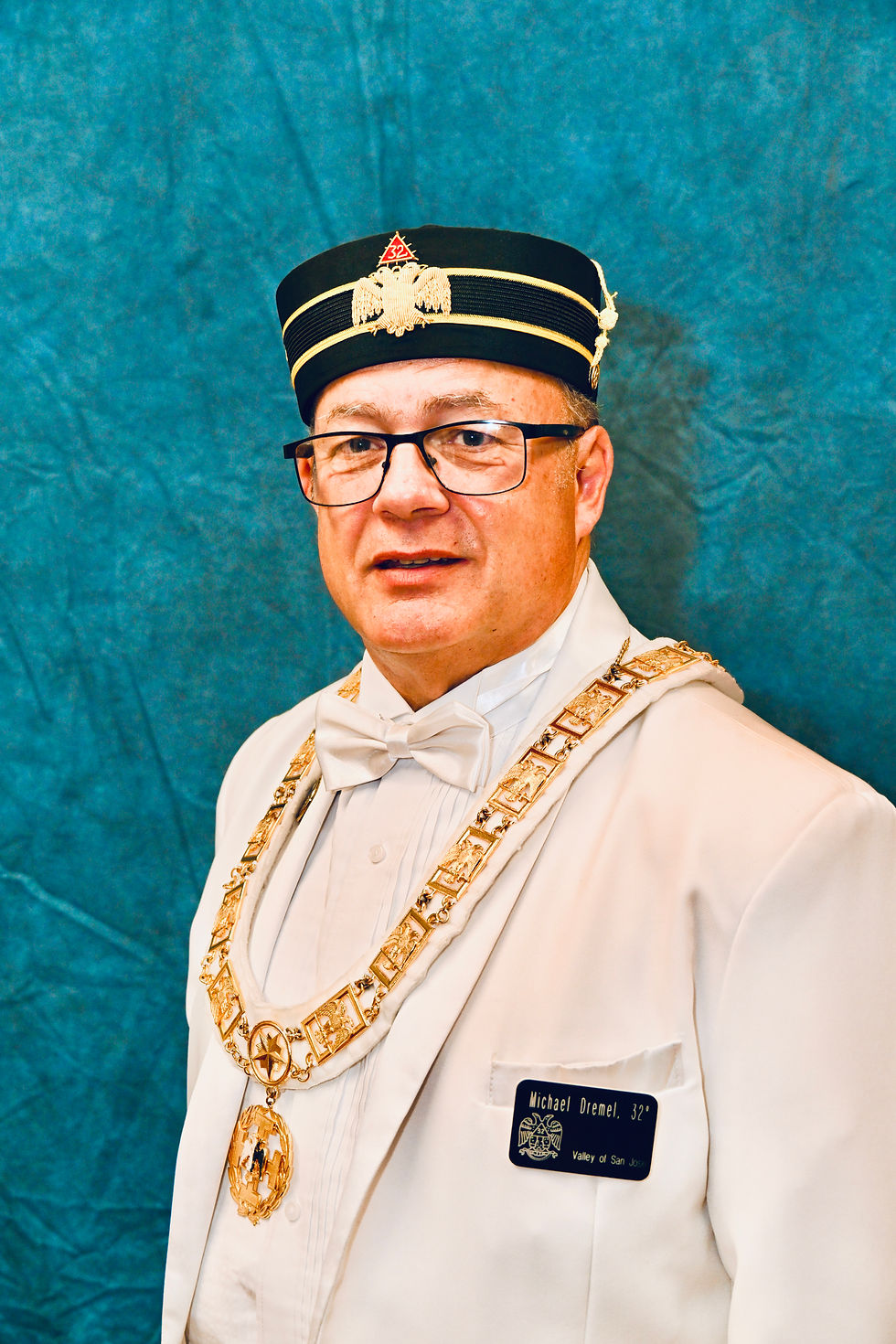
San Jose Council of Kadosh Michael Dremel, 32° 2024 Commander of Kadosh

From the Master of Kadosh (March 2026)
Greetings, and I hope all are well this month.
Thank you to all who were able to attend the stated meeting and Sweethearts Dinner for the month of February. Attendance was great, and the music was a perfect touch, thanks to Noe for setting us up with Jerry the One Man Band. The Super Bowl party was enjoyed by all, and there was a copious amount of food. Thank you to everyone who attended, and a huge thanks to Jeff Toone and others who helped set up and make the day smooth and memorable.
Notably, March 20 also marks the Vernal Equinox. Reflections upon the Preceptor’s words in the first section of the 32nd Degree demonstrate the deep importance of the trestle board of the sky. The word vernal means “of or relating to spring.” The word equinox comes from the Latin aequinoctium, meaning “the time of equal days and nights,” from equi-, meaning “equal,” and nocti-, meaning “night.” Equinox, therefore, is not referring to a day, but to an actual moment in time.
The Vernal Equinox, which we are about to pass through, marks the first of four solar events to occur throughout the year, signifying our transition between the seasons. Our earthly sphere is finally awakening from its winter slumber, arising from these last few months of cold and darkness. The Autumnal and Vernal Equinoxes are the times of year when day and night are of equal measure. The Vernal Equinox is the beginning, a fresh start, emerging anew from the death and darkness of the previous year, with increasing rays of light from this day forward and advancing toward the next celestial event. Within this natural display of religion, science, and astrology, all agree that this period is a time of growth and new beginnings.
The first of the astrological signs that begins on this day is Aries. Aries marks the first 30 degrees of longitude upon our celestial trestle board. Derived from Latin, Aries literally means ram, and logically the ram is its astrological symbol. It is not the only god represented as a ram. The Egyptian god Amun, and later Khnum, were also represented in this form, symbolizing fertility and rebirth. The symbol of the ram has been a major part of our culture and can even be found in Ancient Greek mythology in the story of the Golden Fleece.
Many groups and cultures consider the Vernal Equinox to be a specific marker. The Persian New Year, Nowruz, with its roots in Zoroastrianism, falls directly on the Vernal Equinox. The Wiccan holiday Ostara is also directly tied to the Vernal Equinox. In ancient Rome, followers of Cybele looked at this time of year as one of miracles as well. The Mesoamericans also held this time sacred. El Castillo, Spanish for “the castle,” is found in the middle of Chichén Itzá, standing 79 feet tall. The pyramid is also known as the Pyramid of Kukulkán. The shadows of what appears to be a serpent descending the steps of the pyramid are visible for about a week on both equinoxes.
Picture in your mind’s eye the sunset, a distortion of light casting the shadow of a diamond-backed snake upon the stepped terrace of the temple. As the sun continues to sink below the horizon for its daily slumber, the snake appears to slither its way downward. We can all see this easily online, but who would be up for a trip next year to see it in person?
Till next time, God bless.
San Jose Consistory Brandon Dueñas, 32° KCCH 2025 Venerable Master of Kadosh

From the Chief Knight
(March 2026)
Brethren,
The year has started off well for the Knights of Saint Andrew.
On January 17, our first official function was to supply a Color Guard for Golden Rule’s Installation of Officers. Thank you, Golden Rule, for inviting us.
At our regularly scheduled meeting on January 18, we further discussed our participation in the Highland Games for Labor Day Weekend 2026. We are planning to invite the Burlingame, Stockton, Sacramento, San Francisco, and Santa Rosa Scottish Rite KSA chapters to join us. Our goal is to have as many chapters come together as possible.
After the meeting ended, we knighted Brother Neil Gossard.
At our next meeting, March 15, we plan to elevate Brother Phil Bates to Knight of the First Order and then host a BBQ, formally called a Smoker. The BBQ should start around 1:00 p.m. We will provide hamburgers and hot dogs and ask everyone else to bring a side dish for the potluck.
Since our June meeting day falls on Father’s Day, June 21, we will instead meet on June 28.
If you have any questions about KSA, please feel free to contact me or any of my officers. We look forward to the privilege of serving our Brethren. San Jose Knights of St. Andrew Alan Porjesz, 32°
2026 Chief Knight, KSA
The Knights of Saint Andrew 2026 Officers
Chief Knight | Bro. Alan Porjesz 32º |
First Knight | Bro. Mike Lammer 32º |
Knight of the Watch | Bro. Ben Shuford 32º, PCK |
Secretary | Bro. Tim Lynch 32º |
Monk Knight | Bro. Chris Boyes 32º |
Sentinel | Bro. Maximo Mora 32º |
