
Voices of the Valley - February 2026
- Jan 27
- 11 min read
Updated: Jan 27

From the Venerable Master (February 2026)
There are two Scottish Rites in the United States, the Northern Jurisdiction and the Southern Jurisdiction. Within both jurisdictions, there are four principal coordinate bodies that confer the degrees of the Rite.
Southern Jurisdiction Degree Bodies
In the Southern Jurisdiction, the degree bodies are as follows:
Lodge of Perfection, Degrees 4 through 14
Chapter of Rose Croix, Degrees 15 through 18
Council of Kadosh, Degrees 19 through 30
Consistory, Degrees 31 and 32
In addition, there is the honorary Thirty-third Degree.
The Thirty-third Degree
The Thirty-third Degree in the Scottish Rite of Freemasonry is an honorary degree known as Inspector General Honorary. It is awarded for outstanding service to the Rite or to humanity and is not something a member may request.
The degree is conferred by the Supreme Council upon dedicated Masons who have previously received the Knight Commander Court of Honor. It recognizes exceptional contributions and makes the recipient an honorary member of the Supreme Council.
Key Aspects of the Thirty-third Degree
Honorary StatusThe degree recognizes past service and dedication. It is not a higher rank earned through further advancement, though it reflects significant commitment.
Selection Process
Members are nominated and elected by the Supreme Council, either Northern or Southern Jurisdiction, based on exemplary service.
Recognition
Recipients are recognized for deep commitment to Masonic principles and meaningful contributions to the fraternity or to public life.
Symbolism
Recipients are often identified by the distinctive white cap associated with the degree.
Not a RequirementA Mason cannot ask for the Thirty-third Degree. It is bestowed upon those selected.
Northern Masonic Jurisdiction Perspective
In the Northern Masonic Jurisdiction, the Thirty-third Degree is also considered an honorary distinction, often described as a lifetime service award. It recognizes outstanding contributions rather than representing a higher rank.
ConferralThe degree is bestowed by the Supreme Council following a nomination and election process.
SymbolismThe degree includes unique symbols, such as a specific ring, and represents the culmination of Masonic education and service.
Differences Between the Jurisdictions
The Southern Jurisdiction uses the degree format and ritual adopted in the mid-nineteenth century, largely developed by Albert Pike, with relatively few changes.
The Northern Jurisdiction organizes its degrees differently, presents them in a different order, and has replaced some traditional degrees with newer ones.
In both jurisdictions, the degrees are presented through elaborate dramatic presentations that explore philosophy, ethics, and ancient religions, building upon the foundation of Master Masonry.
Degree Bodies and Their Focus
Northern Jurisdiction Overview
Lodge of Perfection, Degrees 4 through 14Confers degrees focused on the inner man and the search for truth.
Council of Princes of Jerusalem, Degrees 15 and 16Confers degrees centered on loyalty to principles and liberty.
Chapter of Rose Croix, Degrees 17 and 18Confers degrees emphasizing love, mercy, and immortality.
Consistory, Degrees 19 through 32Confers the final degrees, often addressing social and moral conflict, culminating in the Thirty-second Degree, Sublime Prince of the Royal Secret.
These bodies operate within a Valley, and members progress through them to receive the degrees, each of which amplifies the moral and philosophical lessons of the Blue Lodge.
San Jose Lodge of Perfection David Kampschafer, 32° KCCH 2024 Venerable Master

From the Wise Master
(February 2026)
Brethren,
May we take a journey to 225 years ago, and even beyond?
As Master Masons in the Scottish Rite, we are given many opportunities to explore our Masonic journey. One may look to our past to find the keys that shaped our organization. While traveling recently to our nation’s capital, I had the opportunity to spend an afternoon with several Brothers at the House of the Temple, home of the Scottish Rite Southern Jurisdiction, USA, as well as the George Washington National Masonic Memorial in Alexandria, Virginia.
This journey finally resolved a mystery that had remained in my mind since visiting Charleston, South Carolina some years ago. While there, I photographed a bronze placard and a granite marker in the French Quarter of old Charleston and was long puzzled by the phrase, “At the Sea of Charleston.” Through further research and travel, I have since uncovered its meaning and historical significance.
These identifiers appear on a stately building now known as the South Carolina Bank and Trust Building, located at the southeast corner of Broad and Church Streets.
The Supreme Council at Charleston
The “Supreme Council at Charleston,” as it was sometimes called, was the first Supreme Council of the Thirty-third Degree in the world. It continues to exist today as the Supreme Council Southern Jurisdiction, and its Sea, meaning its seat of authority, remains in Charleston, even though its physical residence was later moved to Washington, D.C., where it now resides at the House of the Temple.
As the premier Supreme Council, it naturally exercises authority throughout the United States.
In August 2001, the Scottish Rite Southern Jurisdiction celebrated its two-hundredth anniversary in its birthplace of Charleston, South Carolina. During the multi-day celebration, members of the Supreme Council and invited guests dedicated the granite marker located at the corner of Broad and Church Streets, the former site of Sheppard’s Tavern.
The inscription referencing the Sea of Charleston is engraved on the face of the stone. The top depicts an etching of Sheppard’s Tavern, while the sides display the founders of the Supreme Council.
The Origins of the Ancient and Accepted Scottish Rite
Southern Jurisdiction, USA
The Ancient and Accepted Scottish Rite, Southern Jurisdiction, USA, has layered origins that are part historical, part philosophical, and part symbolic. The following overview separates documented history from traditional influences.
European Origins, 1700s
France is the birthplace of what would later become the Scottish Rite.
The Rite did not originate in Scotland
It emerged in France between approximately 1730 and 1760
French Masons developed higher degrees beyond the three Blue Lodge degrees
These degrees drew upon biblical narratives, medieval chivalric ideals, Enlightenment philosophy, and classical and Egyptian symbolism, all used allegorically.
By the late eighteenth century, these degrees were systematized into a twenty-five-degree system known as the Rite of Perfection.
The Rite of Perfection, 1760s to 1780s
A key figure during this period was Étienne Morin.
In 1761, Morin received authority in Paris to propagate the Rite of Perfection
He introduced it to the Caribbean, particularly Saint-Domingue, now Haiti
This system consisted of twenty-five degrees and served as the direct ancestor of the thirty-three-degree Scottish Rite. It spread through French and Caribbean Masonic networks.
Expansion to the Americas
Many Masons initiated in the Caribbean later settled in South Carolina, Louisiana, and Jamaica. Charleston, South Carolina became a central hub for these higher degrees.
Several future founders of the Southern Jurisdiction had received high degrees outside the United States, granting legitimacy to the formation of a governing body.
Founding of the Southern Jurisdiction, 1801
On May 31, 1801, in Charleston, South Carolina, the Supreme Council was established under the title:
“The Supreme Council of the Thirty-third Degree for the United States of America”
It later became known as the Supreme Council, Southern Jurisdiction, USA.
This was the first Supreme Council in the world and the body that finalized the thirty-three-degree structure.
Key founders included John Mitchell, Frederick Dalcho, and Alexandre de Grasse-Tilly, who played a significant role in spreading the Rite internationally.
Development of the Thirty-Three Degrees
The original twenty-five degrees of the Rite of Perfection were expanded
Degrees twenty-six through thirty-three were added
The system was organized into four principal bodies
Lodge of Perfection, Degrees Four through Fourteen
Chapter of Rose Croix, Degrees Fifteen through Eighteen
Council of Kadosh, Degrees Nineteen through Thirty
Consistory, Degrees Thirty-one and Thirty-two
Supreme Council, Degree Thirty-three
This structure was codified by the Southern Jurisdiction and later adopted worldwide.
Philosophical and Symbolic Influences
The Rite incorporates symbolism drawn from Hebrew scriptures, Christian chivalry, classical philosophy, and Hermetic and Egyptian traditions. These elements are symbolic and instructional, not claims of literal descent.
Why It Is Called Ancient and Accepted
“Ancient” reflects respect for traditional moral teachings and legendary history.“Accepted” refers to the inclusion of speculative, non-operative Masons.
This title was standardized by the Southern Jurisdiction in the early nineteenth century.
Summary Timeline
1730 to 1760, higher degrees develop in France1761, Morin authorized to spread the Rite of Perfection1760s to 1790s, expansion through the Caribbean and North America1801, Supreme Council founded in Charleston, South Carolina1801 to 1813, thirty-three-degree system finalized
San Jose Chapter of Rose Croix Frank Fitzgerald, 32° KCCH 2024 Wise Master
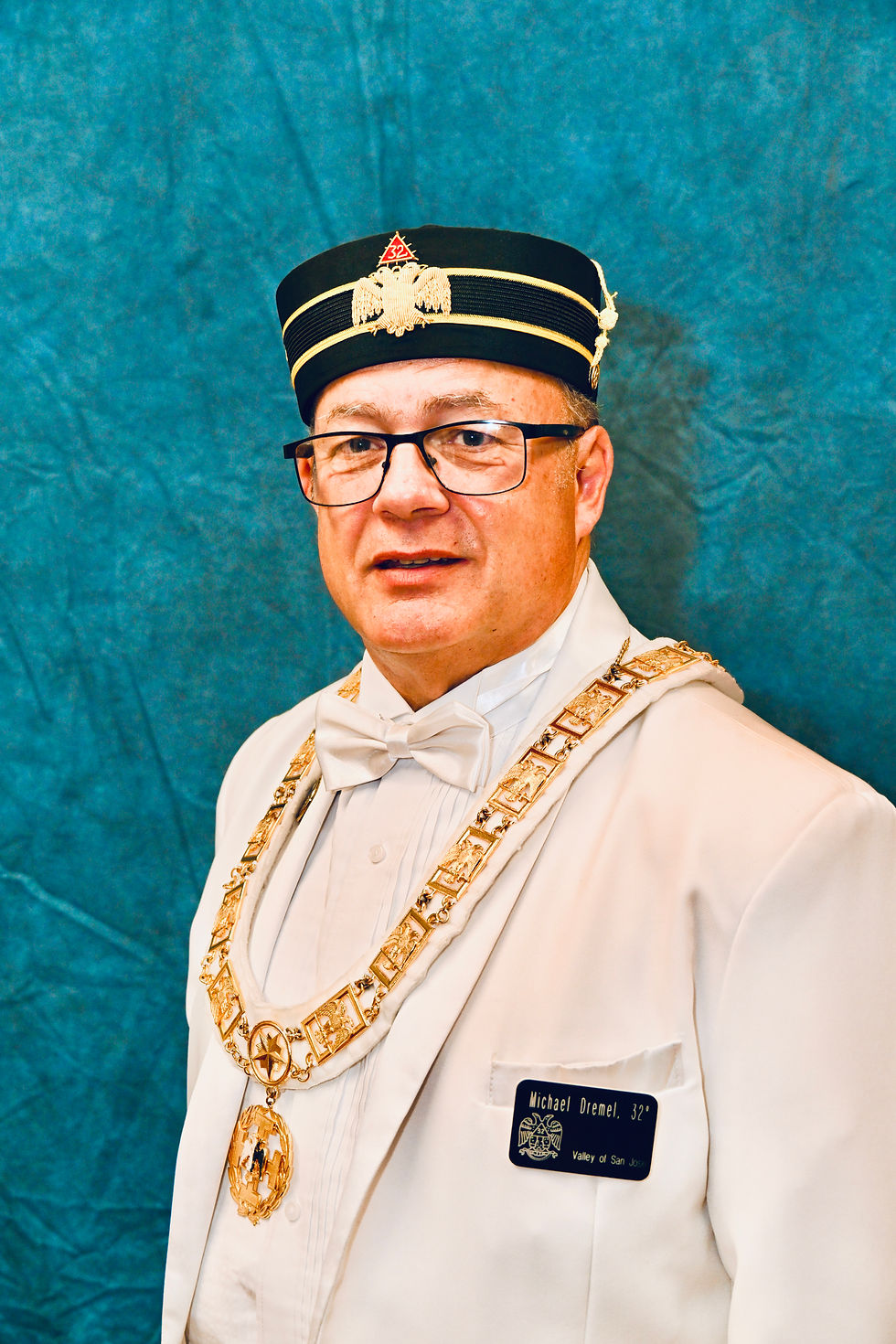
From the Commander of Kadosh (February 2026)
When Freemasonry Was on Trial
Anti-Masonry, Reform, and the California Answer
By Brother Michael J. Dreme - Carmel Lodge No. 680, California
In the early decades of the American republic, Freemasonry faced an unprecedented challenge, not borne of kings or churches, but from fellow American citizens. The Anti-Masonry Movement emerged in the late 1820s and charged that Freemasonry was incompatible with democracy itself and posed a threat to the national government.
This challenge forced the Craft to confront a fundamental question. How does a fraternity devoted to moral improvement coexist with a society committed to transparency and the rule of law?
The eventual answer, most poignantly evident in California lodges, reshaped American Masonry, a legacy that endures today.
The Crisis That Sparked a Movement
The William Morgan Affair of 1826 marked the beginning of the movement. Morgan, a Mason in western New York, announced his intention to publish Masonic rituals and other secrets. He was also known as an unpleasant individual and a failed businessman. He was never raised to the Sublime Degree of Master Mason, meaning his so-called “tell-all” would likely have been based on limited and incomplete knowledge of Masonic ritual.
Shortly after his announcement, Morgan was arrested on minor charges, reportedly indebtedness. He was released, but soon after abducted and never seen again. Several Masons were implicated, and to a suspicious public, the resulting prosecutions appeared slow and ineffective. Some conspirators claimed Morgan had been taken to the Canadian border, paid $500, and warned never to return to New York.
After investigation, twenty-six individuals were indicted. Of these, only six were tried and convicted, not of murder, but of charges related to Morgan’s disappearance. To this day, some historians suggest political motivations influenced the convictions. At the time, many Americans believed Freemasons killed Morgan to silence him and that the fraternity was evolving into an elite, anti-republican organization that viewed itself as above the law.
Worse still was the belief that powerful New York politicians and judges were Masons engaged in a vast conspiracy to control the United States. Such actions, had they occurred, would have directly violated Masonic obligations and constituted conduct wholly unmasonic.
To many citizens, the episode confirmed a troubling suspicion that Masonic loyalty could supersede civic duty and that oath-bound brothers might shield one another from justice. From this belief emerged the Anti-Masonic Party, the first organized third party in United States political history.
Anti-Masons argued that secret societies were incompatible with republican government, that unseen obligations undermined accountability, and that Freemasonry represented a “state within a state.” These concerns resonated deeply within a young nation wary of aristocracy and concentrated power.
What Anti-Masonry Misunderstood
Anti-Masonry mistook symbolic secrecy for political conspiracy. Masonic law, then as now, explicitly subordinates fraternal obligation to civil authority. A Mason is required to be a peaceable citizen, loyal to his government, and obedient to the laws of the land. Any obligation that conflicts with civil law is therefore invalid.
Masonic secrets consist of ritual symbolism and methods of recognition, tools for moral instruction rather than mechanisms of control. Lodges possess no political authority, and partisan politics have long been restricted from discussion within the lodge.
Yet Anti-Masons were not entirely wrong. Early American Masonry often appeared insular, elitist, and insufficiently transparent. Where explanation was absent, suspicion naturally filled the void.
Masonry’s Response: Reform, Not Retreat
The most significant aspect of the Anti-Masonic episode lies not in the criticism, but in Masonry’s response.
Rather than retreating further into secrecy, American Masonry undertook meaningful reform. Constitutions and codes were clarified. Disciplinary procedures were strengthened and codified. Proceedings were increasingly published. Public charity and civic service were emphasized and openly communicated.
By the end of the nineteenth century, Masonry had learned a vital lesson from the Morgan Affair. Public trust requires visible public service.
Nowhere was this transformation more clearly evident than in California.
California Masonry: A New Expression
California Masonry emerged after the Anti-Masonic crisis had already reshaped the Craft. Founded amid statehood, frontier conditions, and democratic aspiration, California lodges emphasized education, civic partnership, and community visibility.
Rather than exercising quiet influence, California Masons helped build public institutions such as schools, libraries, and charities that were open, accountable, and enduring. Leadership was expressed through public good rather than private advantage.
John Swett: The Answer in Practice
Among the most compelling embodiments of Masonic reform was John Swett, often called the Father of California Free Public Education. Arriving from New Hampshire during the Gold Rush, Swett observed that education in California was inequitable due to a tuition-based system.
Middle-class merchants could afford to educate all their children, while working families were often forced to choose only one. Swett believed this disparity would lead to entrenched class divisions. He began advocating for reform through public education, lobbying, and civic engagement.
Swett became California’s first elected Superintendent of Public Instruction and championed policies that reshaped the state’s educational system. He proposed free, tax-supported public schools for all children, robust state oversight, and the principle that education was a civic rather than sectarian enterprise.
His work was conducted openly through legislation, public addresses, and democratic institutions. His Masonic values were expressed not through secrecy, but through universal access to education and the enlightenment of the citizenry.
Swett’s life stands as a direct rebuttal to Anti-Masonic fears. He demonstrated that Masonic principles lead outward to service rather than inward to privilege or prestige.
Why This History Still Matters
The Anti-Masonic movement reminds modern brethren that secrecy without explanation breeds mistrust. Masonry endured not by defending mystery, but by demonstrating values that served society at large.
For over a century, California Masonry has answered its critics through visible service, ethical conduct, generous education, and the creation of institutions that belong to and serve everyone. These remain the Craft’s strongest response, past and present.
In Closing
Even today, echoes of Anti-Masonic fear persist, though in altered forms. Modern conspiracy narratives often mirror nineteenth-century anxieties about secret influence and unseen power. In some cases, agencies have required individuals to disclose Masonic affiliations as a result of this lingering suspicion.
Given this climate, it is incumbent upon Masons to dispel fear through conduct, by acting justly, uprightly, and visibly according to the lessons of our rituals and ideals.
Anti-Masons once feared that Freemasonry would undermine democracy. Through decades of service, demonstrated uniquely by each lodge, California Masonry has instead strengthened and protected the liberties upon which that democracy stands.
San Jose Council of Kadosh Michael Dremel, 32° 2024 Commander of Kadosh

From the Master of Kadosh (February 2026)
Greetings and welcome to the New Year.
The officers of the San Jose Consistory hope you had a joyous holiday season and that the New Year has been fruitful thus far.
The officers have plans for an upcoming bocce ball day later this year. This event is always well attended, with guests well fed, plenty of smiles, and lasting memories shared while strengthening our friendship.
Much closer on the horizon is our Super Bowl potluck on Sunday, February 8th, beginning at 12:00 PM, with kickoff at 3:30 PM PST. This event has been a blast and well attended each year.
The San Jose Consistory officers would like to thank you again for your attendance at this year’s Installation of Officers. Looking ahead to March, we will spend some time exploring the significance of the Vernal Equinox.
Until next month, take care, and God bless.
San Jose Consistory Brandon Dueñas, 32° KCCH 2025 Venerable Master of Kadosh

From the Chief Knight
(February 2026)
Brethren,
As my year as Chief Knight begins, I look forward to serving the Valley of San Jose Scottish Rite. I am very pleased with the Brothers who have stepped up to assume their support roles in the Knights of Saint Andrews.
On Sunday, January 10th, I presided over my first meeting with the Knights as Chief Knight. The meeting was well attended, and old, unfinished, and new business was discussed. Two of the Brothers stepped up to fill the vacancies for Knight Monk Keeper of the Grail and Sentinel.
It was reaffirmed that any Scottish Rite Brother in good standing who has received the 29th Degree may join our service group.
A committee was formed to organize our participation in the 2026 Highland Games, scheduled for Labor Day weekend, September 5 and 6, at the Alameda County Fairgrounds in Pleasanton. We will be hosting a hospitality tent, which we will be sharing with Ill. Bro. Bud Ramsey and his clan group, the Firth of Forth Clan of the Royal Order of Scotland.
As we Knights like to say, “This is the largest non-Masonic Masonic event of the year.” It is much like attending Annual Communications and meeting one Mason after another, so please keep your calendar open for this special event.
At the conclusion of our meeting, a barbecue followed, featuring chicken and fish as the main course. An afternoon of good fellowship was enjoyed by all.
We meet on the third Sunday of each month at high noon, downstairs, and all are welcome to come join us.
If you have any questions, please feel free to ask me or any of my officers. We look forward to the privilege of serving our Brethren.
Sincerely and fraternally, San Jose Knights of St. Andrew Alan Porjesz, 32°
2026 Chief Knight, KSA
The Knights of Saint Andrew 2026 Officers
Chief Knight | Bro. Alan Porjesz 32º |
First Knight | Bro. Mike Lammer 32º |
Knight of the Watch | Bro. Ben Shuford 32º, PCK |
Secretary | Bro. Tim Lynch 32º |
Monk Knight | Bro. Chris Boyes 32º |
Sentinel | Bro. Maximo Mora 32º |
