
Voices of the Valley - June 2026

From the Venerable Master (June 2026)
Rough and Perfect Ashlars
Rough and Perfect Ashlars are stones that serve to symbolize a man’s spiritual and moral life.
It is not easy to cut stones into perfect sizes and shapes. It requires experience, patience, discipline, and the skill of true craftsmen.
In history, only large buildings were commonly made of ashlars. Other buildings were often built with brick and wood. It was difficult to assemble skilled craftsmen who knew how to lay foundation stones, place stones correctly on top of one another for tall buildings, and build stone archways. It was also difficult to find artisans who could sculpt stones into ornamental shapes.
Rough ashlars were cut and raised by apprentice masons under the supervision of Fellowcrafts, who were experienced craftsmen.
Master Masons served as the general supervisors. They had proved themselves capable of preparing ashlars to the satisfaction of their superiors.
There are two forms of ashlars in Freemasonry: the Rough Ashlar and the Perfect Ashlar.
Rough Ashlar
The Rough Ashlar represents an unprepared, undressed stone in Operative Freemasonry. In Speculative Freemasonry, the Rough Ashlar represents an uninitiated Freemason before he becomes enlightened.
Perfect Ashlar
The Perfect Ashlar is the dressed stone that has been shaped, smoothed, and made uniform with the mallet, chisel, and other working tools. The chisel is used in English Freemasonry, but it is not used as a Freemasonic symbol in the United States. The Perfect Ashlar is the finished stone that has been prepared by experienced stonemasons and fitted into architectural buildings and structures. A Perfect Ashlar symbolizes a Freemason who works to achieve a purposeful, principled, and righteous life, and who does all he can to become enlightened.
Rough and Perfect Ashlars
The Rough and Perfect Ashlars are symbolically used in the Fellowcraft Degree. Through education and the acquisition of knowledge, a man can improve his moral and spiritual being.
A Rough Ashlar begins as an imperfect stone. Likewise, a man is initially imperfect. Through brotherly love, cultivation, and education, he can be shaped into a better man. He becomes someone who has been tried by the square of virtue and encircled by the compasses of the boundaries given to him by the Creator.
Rough and Perfect Ashlars Fitted for Use by the Builder
In the days of old, quarried stones that could easily be shaped into the required configurations were called “freestone.” Examples of freestone include sandstone and limestone. These rough stones had to be refined and smoothed before they could be used.
In the Fellowcraft Degree, the Rough Ashlar represents the unrefined state of man and the need for improvement. The unrefined man learns that he can become better through improved conduct and greater spirituality of thought. He is charged to become a better person through obligations, expectations, and duties.
A Freemason continually smooths his external and internal rough edges in order to become a better man and a better Freemason. Once a man has smoothed his ashlar to the best of his ability, he begins to help his Brothers become better men and better Freemasons.
Rough and Perfect Ashlars and Man’s Capability for Change
All Rough Ashlars have the potential to become Perfect Ashlars. First, however, the Rough Ashlar must be made of solid material, and its flaws must not be so severe that it cannot be shaped. It must be receptive to change and capable of being worked into a perfect stone.
In the same way, candidates for each Masonic degree are asked many questions so that more may be learned about their character and qualifications.
Candidates must have the capability to serve and support the Brotherhood. They must be carefully inspected to determine whether they can fit within Masonic goals and tenets, and whether they can remain compatible with God’s laws.
An imperfect ashlar can be made perfect, but some major flaws are difficult to change. These flaws can weaken a structure when the ashlar is fitted into it. This applies to both men and stones.
Rough and Perfect Ashlars and States of Metamorphosis
Freemasonry is a noble and ancient Brotherhood with a long history. A flawed ashlar can bring negative thoughts, reproach, and embarrassment to the Brotherhood from those outside of it. For this reason, flawed ashlars cannot be allowed to join the Brotherhood.
At the same time, we must remember that Perfect Ashlars are not simply found in the stone quarries. They must be hammered, chiseled, and polished before they reach their perfected state.
It is difficult to find “perfect men” who exist without Brotherly light, guidance, and love. It is also difficult to find Freemasons who have not been in the state of both Rough and Perfect Ashlars at some point in their lives.
How Freemasons Can Contribute to the Making of Other Perfect Ashlars
Freemasons must seriously consider their personal responsibility to educate other Brothers toward improvement. We become enlightened when we assist others and give to those in need. Master Masons uphold the tenets of the Craft and teach other Brothers what they have learned.
All Lodges must take time when judging the potential of a candidate. They must weigh his character and evaluate his potential for change.
All Freemasons must extend a friendly hand of affection and love to help new Freemasons become better men. We must help them stand upright with the plumb, live on the square, and become true Freemasons who will make the Creator proud.
All worthy men must take the lesson of the Rough and Perfect Ashlar seriously. We must embrace these lessons so that we may become more knowledgeable and less ignorant, move from death to life, and pass from darkness to light.
San Jose Lodge of Perfection David Kampschafer, 32° KCCH 2024 Venerable Master

From the Wise Master
(June 2026)
Our Scottish Rite Degrees Can Differ by Jurisdiction If you have become a follower of my Rite Word writings since January 2026, you may recall that I wrote about the year 1801 and the beginning of the Mother Supreme Council of the 33° of the Southern Jurisdiction of the United States of America, whose seat is in Charleston, South Carolina.
In August 2001, the Scottish Rite Supreme Council, Southern Jurisdiction celebrated its 200th anniversary in its birthplace, where Lodge members once met at Shepheard’s Tavern, at the intersection of Broad and Church Streets in the French Quarter of downtown Charleston.
The “Supreme Council at Charleston,” as it was sometimes called, was the first Supreme Council of the 33° in the world. It continues to exist today as the Supreme Council, 33°, Southern Jurisdiction, and its seat remains in Charleston.
It was French Master Masons who developed the “higher degrees” for the Scottish Rite and offered them to the newly founded Southern Jurisdiction. These degrees drew upon:
Biblical narratives, including Solomon’s Temple, exile, and restoration
Medieval chivalric ideals
Enlightenment philosophy
Classical and Egyptian symbolism, used allegorically
This month, I write to you from the banks of the Mediterranean Sea, in the city of Marseille, France. I will show how the degrees presented by the Supreme Council, Southern Jurisdiction compare to those of the Supreme Conseil National de France. Each has grown over time to differ slightly in how the degrees are organized within each Scottish Rite Jurisdiction.
Supreme Conseil National de France
The Ancient and Accepted Scottish Rite is the most widely practiced Rite of “High Masonic Degrees” in France and throughout the world. The term “High Masonic Degrees” refers to degrees that go beyond the first three symbolic degrees: Apprentice, Fellowcraft, and Master Mason. These degrees offer a deeper understanding of the themes introduced in the symbolic Lodge.
While the symbolic degrees are managed by Obediences, such as the Grande Loge Nationale Française in France, the high degrees of the Scottish Rite are managed and governed by a Jurisdiction. In France, this is the Supreme Conseil National de France.
The Jurisdiction offers its members a path of spiritual and moral perfection through thirty degrees, each presenting teachings based on myths, allegories, and symbolic legends.
These thirty degrees are practiced in different types of Bodies:
The Lodge of Perfection: 4° through 14°
The Chapter: 15° through 18°
The Areopagus: 19° through 30°
The Tribunal: 31°
The Consistory: 32°
The High Council: 33°
Reference: https://www.scndf.fr
San Jose Chapter of Rose Croix Frank Fitzgerald, 32° KCCH 2024 Wise Master
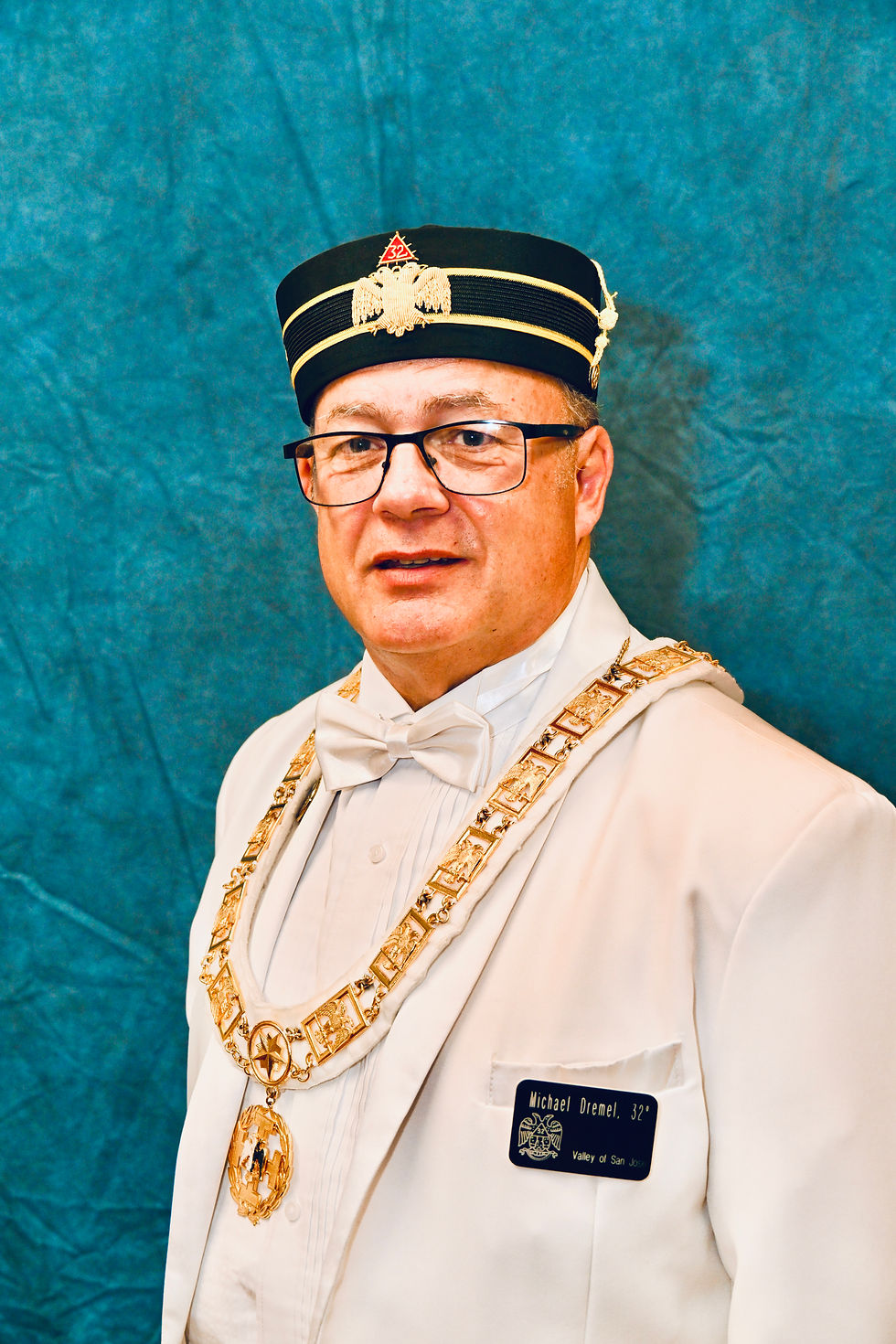
From the Commander of Kadosh (June 2026)
The Quiet Mason
By Michael J. Dremel
There was a time when a Mason’s work was known, but his name was not.
In the early days of the Gold Rush, Freemasons were among the quietest architects of civil society. In a nascent state defined by rapid growth and uncertain order, it was the Masons within the state who established schools, supported widows and orphans, and laid the moral and civic foundations that might have otherwise remained an untamed or lawless frontier.
Their influence was real and lasting, yet seldom self-promoted. Their satisfaction came not from applause, but from the simple knowledge that what they had done was right.
They were, in every sense, Quiet Masons.
“The truest work of a Mason is not proclaimed. It is lived.”
One of the clearest Masonic examples of this spirit can be found in Brother John Swett, often called the “Father of the Free California Public School System.” A dedicated Brother, Swett championed free, universal education at a time when such ideas were far from universally accepted. His efforts helped shape the very foundation of our state’s public schools, yet his work was never about personal acclaim. It was about building something enduring for the common good.
Swett embodied the principle that the most meaningful contributions are often those made without fanfare.
Today, we live in a world that encourages visibility, often characterized by egregious self-promotion. Good deeds are frequently shared, posted, and celebrated publicly. While there is nothing inherently wrong with letting others see the good that is being done, indeed, it can inspire others, we should pause and ask ourselves a simple question:
Why are we doing this?
Are we serving for the sake of the work, or for the recognition that may follow?
The answer may be helped by this simple phrase: Freemasonry has never required an audience.
Our obligations are not performed on a stage, but within the quiet halls of our Lodges. They are carried into daily life in how we treat others, how we act when no one is watching, and how we quietly extend a helping hand. The lessons we learn within the Lodge are meant to shape the man, not advertise him.
This is not to suggest that modern Masons have lost their way. Far from it. Across California and beyond, Masons continue to contribute generously to their communities. Scholarships are awarded, relief efforts are organized, and countless acts of kindness take place every day.
But there is a subtle distinction worthy of remembering and preserving.
The Quiet Mason does not diminish the work. He elevates it by removing himself from the center of attention. He understands that the value of charity is not measured in visibility, but in sincerity.
In my own Masonic experience within the Lodges of California, I have seen this spirit alive and well, with each Lodge finding its own unique way to support and fulfill its chosen philanthropic mission. Meals are prepared for those in need. Precious personal time is given without hesitation. Brothers step forward not to be seen, but to serve.
These moments rarely make headlines. They may be captured in photographs or shared among Lodge publications, but they are seldom seen in major media except on the rare occasions when warranted. And yet, they represent the very essence of what it means to be a Mason.
Perhaps the challenge for Masons today is not to retreat from the modern world, but to carry this timeless principle forward within it. If we are true to our tenets, the communities we serve may come to recognize and even follow those same principles.
To do the work.
To live the values.
To serve quietly and faithfully, without expectation of reward.
Because in the end, the legacy of a Mason is not found in what is said about him, but in what he has done for others, often when no one was looking.
San Jose Council of Kadosh Michael Dremel, 32° 2024 Commander of Kadosh

From the Master of Kadosh (June 2026)
A Sense of Community
A sense of community is something every person desires. It is one of the underpinning links in the chain of society.
Everyone wants to belong and to feel that their presence adds value. Everyone wants to be part of a greater whole. This concept is deeply rooted not only in our country, but throughout the world, across human associations, cultures, and religions.
When one looks with a keener eye, we find a deeper love and appreciation for community as expressed through God and country.
Community Through Shavuot
Community is observed through the eyes of the Jewish faith during Shavuot. This religious observance centers on the grain harvest and the giving of the Torah. Shavuot is one of three ancient pilgrimage festivals and focuses on the synagogue, community, and ritual.
The community gathers at the synagogue for special readings, including medieval poems and the Book of Ruth. The Book of Ruth is important because its setting takes place during the barley harvest. Ruth’s acceptance of Naomi’s religion is also symbolic of the Israelites accepting the Torah at Sinai.
According to rabbinical tradition, this season also includes the time when King David died, which is reflected in the concluding readings of Ruth.
A strong sense of community is also observed during the all-night study sessions of Tikkun Leil Shavuot. During Shavuot, both Hallel, the Psalms of Praise from Psalms 113 through 118, and Yizkor, a memorial service, are observed.
Through the community of Shavuot, historic consciousness is found. One can observe that it takes the form of a covenant between God above and Israel at Mount Sinai below. It is also symbolic of a marriage between God and the community of Israel, celebrated in hope and in the springtime of that sacred relationship.
Community Through Country and Flag
The Star-Spangled Banner, the Stars and Stripes, and Old Glory are just a few of the names by which the flag of our country is known. This month, we have the opportunity to pay our respects to our flag, the symbolic emblem of our nation.
June 14 was chosen by Bernard Cigrand in 1885 as a day to hold a “Flag Birthday,” or “Flag Day.” He arranged this observance for his students in Fredonia, Wisconsin.
In 1889, George Balch of New York did the same for his pupils. Two years later, the New York school board formally adopted the observance. Many important groups and individuals supported the tradition, and it continued to grow.
On June 14, 1894, more than 300,000 school children observed Flag Day.
This observance was not only for children. In 1914, Franklin K. Lane spoke about what the flag symbolically said to him that morning:
“I am what you make me; nothing more. I swing before your eyes as a bright gleam of color, a symbol of yourself.”
The celebration became an official observance when President Woodrow Wilson issued a proclamation in 1916. On August 3, 1949, our Brother and President Harry Truman signed an act of Congress designating June 14 of every year as National Flag Day.
Since that day, we have had the opportunity to honor the flag of our great country every year.
We have a community of children, teachers, and leaders to thank for this, along with a little help from a Brother.
Take a moment and listen to our Brother Red Skelton’s rendition of the Flag Salute online. What a wonderful sense of community, country, and God.
San Jose Consistory Brandon Dueñas, 32° KCCH 2025 Venerable Master of Kadosh

From the Chief Knight
(June 2026)
Brethren,
We opened our May meeting with a
Moment of Silence for our departed
Brother, the Ill. .Royce M. Ford. Though he was not a member of the Knights of Saint Andrews, he was our Brother.
Our April 30th meeting was well attended and as usual our main concern was the Highland Games so mark your calendars for September 5 & 6, Labor Day Weekend. Our tent spaces have been purchased and Burlingame is planning to join us at the games. We are still waiting to hear from the Oakland KSA. Three (3) more Brothers have expressed a desire to join KSA and were invited to join our May 17th meeting.
For those who might not be aware of what the Knights of Saint Andrews does, we are a service organization. We are the Greeters at the front door. We are the bus boys, picking up your dishes at the dinner table, We are the Bartender pouring your drink at the dinners, We serve wherever needed and can be identified by the Glengarry or Balmoral headgear that we wear when we are not wearing our Black Garrison headgear.
Our next regularly scheduled meeting has been moved to the 4th Sunday of June, the 28th due to Fathers Day falling on the 3rd Sunday the 21st. All Scottish Rite Masons who have received the 29th Degree are invited to join us. San Jose Knights of St. Andrew Alan Porjesz, 32°
2026 Chief Knight, KSA
The Knights of Saint Andrew 2026 Officers
Chief Knight | Bro. Alan Porjesz 32º |
First Knight | Bro. Mike Lammer 32º |
Knight of the Watch | Bro. Ben Shuford 32º, PCK |
Secretary | Bro. Tim Lynch 32º |
Monk Knight | Bro. Chris Boyes 32º |
Sentinel | Bro. Maximo Mora 32º |
