
Voices of the Valley - July 2026

From the Venerable Master (July 2026)
Do you know the word Shibboleth?
Do you know what it means?
The word "Shibboleth", (in Hebrew: Sihlet-Shabioth) was used in ancient times to distinguish friend from foe.
It is the pronunciation and interpretation of the test word used by the troops of Jephthah to distinguish the Ephraimites after the battle on the banks of the Jordan.
The word comes from the Hebrew Bible (Book of Judges). When the Gileadites were at war with the Ephraimites, they used the word "shibboleth" (meaning "stream" or "flood") as a password.
Because the Ephraimite dialect lacked the "sh" sound, they pronounced it "sibboleth".
This is the reason it was used as the test word is because the Ephraimites' dialect was somewhat different than the troops of Jephthah, and if they pronounced the word incorrectly, they failed the test and were put to instant death.
"Shibboleth" has two meanings:
• A place to cross the water (a waterford)
• Corn (or, generically, grain), which is an emblem of the germination force of the seed.
Note: Some Grand Lodges use the word "waterfall" in place of the word "waterford".
This word was also explained on the TV show West Wing with Martin Sheen
San Jose Lodge of Perfection David Kampschafer, 32° KCCH 2024 Venerable Master

From the Wise Master
(July 2026)
The Rose Croix Tradition is among the easiest Masonic emblems to interpret. The rose and cross stands as one of the great combined symbols of Freemasonry, perhaps second only to the square and compasses.
For the Christian Mason, the cross refers to Jesus Christ. In a broader sense, however, it represents self-sacrifice for the redemption and betterment of mankind.
The rose, one of the most beautiful of flowers, symbolizes perfection, hope, renewal, and the awakening or resurrection of life. Together, the Rose Croix symbolizes faith and hope in immortality, attained through sorrow, sacrifice, and devotion to higher principles.
The Rose Croix Tradition teaches that the world is what it is, and that our task is to respond to it in a way that allows good and the law of love to prevail. This calls for a constant struggle within ourselves and within society.
Faith in God and in mankind is Wisdom; hope in the triumph of good over evil gives Strength; and charity toward all living creatures - expressed through respect for life, tolerance, and selflessness - is Beauty.
San Jose Chapter of Rose Croix Frank Fitzgerald, 32° KCCH 2024 Wise Master
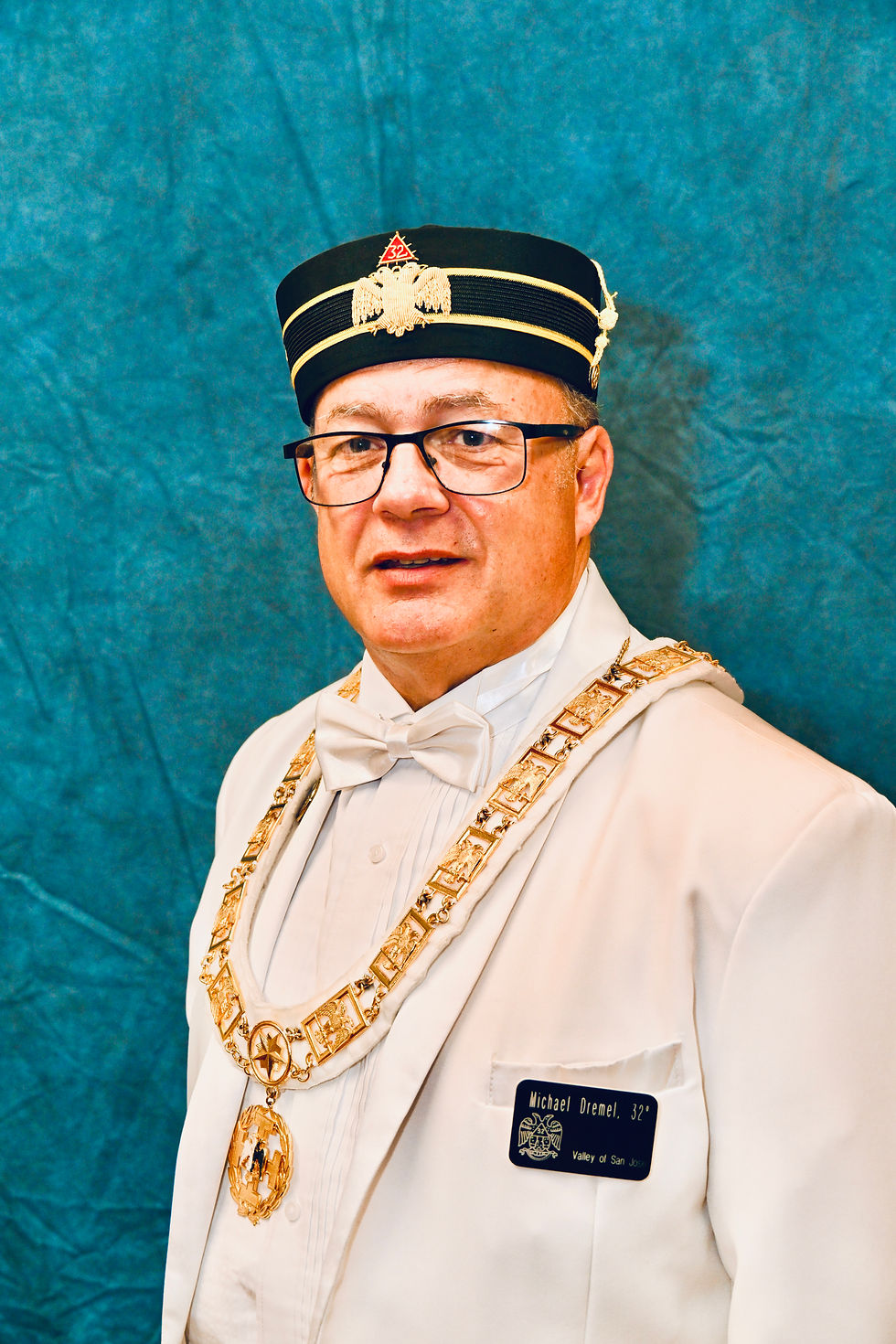
From the Commander of Kadosh (July 2026)
A Ruler’s Real Legacy by Brother Michael Dremel,
Commander of the SJ Council of Kadosh
History often remembers rulers for the battles which they won, the territories they conquered, and the monuments they built. Yet the true measure of leadership may be found elsewhere. Centuries after a kingdom’s borders have disappeared and its armies have vanished from memory, the ideas, institution(s) and values established by a ruler may continue shaping the world they ruled and beyond.
Such is the case of Charlemagne, King of the Franks and Emperor of much of Western Europe during the late eighth and early ninth centuries. While historians rightly acknowledge his military achievements and political acumen, his enduring legacy may not be the empire he built, but rather the revival of learning he encouraged. Through the efforts of such scholars such as Alcuin of York and countless others, Charlemagne helped spark what historians now call the Carolingian Renaissance - a movement whose effects would echo through the centuries and ultimately influence many of the ideas that Freemasons cherish today.
To appreciate the significance of this achievement, we must first understand the world which Charlemagne inherited. Following the collapse of the Western Roman Empire, Europe experienced centuries of political fragmentation and cultural decline. Literacy diminished, educational institutions weakened, and many works of classical learning were at risk of being lost. Knowledge survived, but often only in isolated monasteries and scattered centers of learning.
Charlemagne recognized that military strength alone could not sustain a civilization or even a throne. A vibrant kingdom with cultural growth and intellect required educated administrators, knowledgeable clergy, and informed citizens. More importantly it required a commitment to preserving and transmitting wisdom from one generation to the next. In this respect, this medieval king’s vision extended far beyond conquered lands and honors.
One of Charlemagne’s most important decisions was inviting the English scholar Alcuin of York to join his court. Alcuin was already respected as one of the leading intellectual figures of his age. Under Charlemagne’s patronage, Alcuin became a driving force behind educational reform throughout the empire. Together, Charlemagne and Alcuin established schools, improved standards of instruction, and encouraged the study of grammar, rhetoric, logic, mathematics, astronomy, music and theology, most of which we hear alluded to in our own rituals.
They promoted literacy among clergy and officials. They sponsored the copying of manuscripts so that prior knowledge would not be lost to time. These efforts may seem modest when compared to military campaigns, conquests or political reforms, yet their long-term impact proved extraordinary when viewed through lens of history.
Many of the classical works that survived until today owe their preservation initially through tireless efforts of Carolingian scholars and scribes in monasteries. In such monasteries and scriptora throughout the empire, manuscripts were copied, corrected, and preserved for future intellectuals to use in their work. Without such efforts, much of the intellectual heritage of Greece and Rome might have disappeared.
A particularly significant achievement was the development and widespread use of Carolingian minuscule, a clear and standardized form of handwriting. While it may appear to be a minor innovation, it greatly improved readability and facilitated the accurate transmission of texts. In a very real sense, minuscule helped make knowledge more accessible before the printing press was invented.
If Charlemagne supplied the vision, Alcuin supplied the tools. Together they undertook a project that was not unlike the work of a master builder. Rather than constructing walls and towers, they sought to build minds and institution capable of supporting civilization itself.
As Freemasons, we often speak allegorically of building. Our symbols remind us that the work of improving society begins with the individual and then ultimately extends to society. We use the language of architecture to describe moral and intellectual growth. The rough ashlar becomes the perfect one through effort, discipline and instruction. The working tools teach lessons of self-improvement, responsibility, and service to others.
Although separated from Freemasonry by many centuries, the Carolingian Renaissance left its mark on our craft. Charlemagne and Alcuin recognized that civilization is not maintained automatically. Knowledge must be preserved and integrated into our actions. Virtue must be taught, and wisdom must be passed accurately and fully from one generation to the next, be it in a library, temple or masonic lodge.
Their efforts also illustrate an important truth about leadership. The greatest leaders are not necessarily those who accomplish everything by themselves. Rather, they create conditions in which others may flourish and contribute in their own way to society. Charlemagne’s lasting influence came not merely from his own actions but from his ability to recognize scholarly talent, encourage scholarship, and support institutions that would outlive their empire.
The fruits of the Carolingian Renaissance did not appear overnight. The schools established during this period helped preserve learning through the Middle Ages. Those foundations contributed to the growth of universities, the revival of classical scholarships during the Renaissance, and the intellectual development of the Enlightenment - all of which eventually influenced our fraternity and allowed it to grow into the learning entity we are today.
The progression from of this is remarkable. Charlemagne encouraged learning and Alcuin organized and expanded educational and cultural norms - a parallel to Solomon and Hiram Abiff. Medieval universities built upon previous works of prior institutions and efforts. Renaissance thinkers at those universities later rediscovered and expanded classical wisdom. Enlightenment philosophers emphasized reason, inquiry, and human improvement, possibly leading to Freemasonry’s motto of “building better men”.
From that intellectual heritage emerged many of the principles that speculative Freemasonry would later embrace: the pursuit of knowledge, the cultivation of virtue, respect for learning, and the belief that individuals possess both the cognitive ability and the responsibility to improve themselves and their communities.
To be clear, Freemasonry does not descend directly from Charlemagne or the Carolingian Renaissance. History is rarely so simple and direct. Yet there exists a recognizable continuity of ideals - the commitment to education, moral development, and enlightened leadership and thought that animated the Carolingian revival remains familiar to every Mason who seeks light and endeavors to share it with others.
This lesson may be especially relevant today. We live in an age of unprecedented access to information, yet information alone does not guarantee wisdom - only thought-out application does that. Knowledge still requires stewardship. Institutions still require care. Each generation must decide whether it will preserve what is valuable, improve what is imperfect or rough, and pass forward something better than it was received.
That responsibility rests not only with kings and scholars, but with all who aspire to leadership. Whether in our families, our professions, our communities, or our lodges, we help shape the next generations by what we choose to teach, preserve, and encourage.
More than twelve centuries after his death, Charlemagne’s empire exists now only in history books. Its borders have long since vanished, and its political structures replaced many times over. Yet, the educational and cultural revival he helped to initiate continues to influence the modern world.
Perhaps that is the true measure of a ruler’s success. Not the lands he controlled, but the lives he influenced. Not the monuments he erected, but the opportunities he fostered or sponsored.
Charlemagne gathered the stones, and Alcuin executed the plans. Generations of scholars raised the walls. The Renaissance opened the windows, and the Enlightenment brought in the light.
As for Freemasons, we inherit the obligations to keep that light burning for all to see. For in the end, a ruler’s real legacy - and indeed the legacy of every builder - is found not in what he possesses through conquest or other means, but in what he leaves behind for others to use to improve their own lives.
San Jose Council of Kadosh Michael Dremel, 32° 2024 Commander of Kadosh

From the Master of Kadosh (July 2026)
Independence Day is a special time for all to celebrate the birth of our nation with the signing of the Declaration of Independence. The Fourth of July officially became a federal holiday in 1941, though its celebration dates back to the 18th century, immediately following the American Revolution. Many orations and speeches from this early period adopted a republican calendar in use through 1800, dating their documents ‘year of the Revolution’, and counting the years since 1776.
Representatives of the thirteen colonies assembled, weighing a resolution to declare their independence from Great Britain. On July 2d the Continental Congress voted in favor of this resolution, two days later adopting the Declaration of Independence, drafted by Thomas Jefferson, Benjamin Franklin, John Adams, Roger Sherman and Robert R. Livingston.
From 1776 through today, the fourth of July has been celebrated as the birth of American Independence with parades, just like the ones celebrated by South Valley 187 and many other lodges, along with our Brother Shriners. Every family has a unique way to celebrate, gathering with food and friends, and my personal favorite, with fireworks.
One of the two zodiac signs this month holds the fire sign. This elemental has been venerated through all time and in all of man’s religions. Zoroastrianism is the first monotheistic faith, which has the burning of fire as a principle element of its worship to create an eternal fire. The earliest religions were religions of nature and evoked universally by Jefferson in the Declaration of Independence as ‘the Laws of Nature and of Nature's God.’
The sun is considered to be the universal fire. Quintus Curtius invoked the sun as Mithras, the sacred and eternal fire. Fire was not the idol of worship itself, but rather the visible symbol of the Supreme Deity. It gives life and light, and is the creator of the energy from where we came, and to where we ascend. The burning flame ascends toward heaven, to its divine origin. Its base symbolically ignites, grows, and ascends towards the celestial fire, or God. This belief is referred to as the ‘flame secret’ by its adherents.
This is the concept of universal religion and is a principal ideology of all ancient religions. It can be observed from India to Egypt, and is encoded in the astrological mythology of the Greeks and the Hebrews, influencing modern thought and religion. In the Hebrew scriptures we see fire used in prominent and divine ways. Upon Mount Sinai God revealed himself to Moses. There the angel of the Lord appeared to him in flames of fire from within a bush. God revealed his name and commanded Moses to lead his people from captivity.
Burnt offerings were the principal form of their worship, providing a sweet-smelling aroma to the Lord, with nothing being returned to the worshiper, making it distinct from other faiths and a true sacrifice. God also answered Elijah’s prayer for a sign of his presence at the altar he constructed and the fire of the LORD fell, and consumed the burnt sacrifice, and the wood, and the stones, and the dust, and licked up the water that was in the trench.
Fire has always been a symbol of Holiness to the Lord, and can be visibly seen by our three lesser lights in our Lodge rooms as symbols of the Great Architect of the Universe. When we delve into the high degrees, and other ancient institutions, we find that fire is used as a process of purification. As fire is identical to light and the symbol of divinity of the Zoroastrtians, Masonry is intimately attached through the equivalent viewing of light as the Divine Truth, and the symbol of the Great Architect.
Brother Edouardo Laboulaye through his vision gave America both liberty and fire, commissioning brother Frederic Auguste Bartholdi to build the Statue of Liberty. It is seen internationally as a beacon of peace, hope, and freedom, symbolizing the friendship and alliance of France and the United States. Freemasons labored to build Lady Liberty together, and this Franco-American Union assembled together some three-hundred pieces shipped across the Atlantic.
The flame of Lady Liberty symbolically burns in her torch, with ‘Liberty enlightening the world.’ We see in our ritual how deeply our brothers put thought into how they could impart this symbol in our gentle craft, for all the world to view. Let us each allow our own flame of Masonry to shine, as our brothers before us, with their knowledge and gifts bestowed upon us all.
San Jose Consistory Brandon Dueñas, 32° KCCH 2025 Venerable Master of Kadosh

From the Chief Knight
(July 2026)
At our June 28tht meeting the main subject was practicing for our Color Guard and Arch of Steel for the Grand Master's Reception. Everyone is looking forward to it as we hope to impress him with our zeal.
We will be dark in July and meet again on August 16th to prepare for the Highland Games on September 5 & 6 at the Pleasanton Fairgrounds where we hope to see many of you. If you have never been to the Games this is a perfect opportunity. You can watch the Caber Toss, the Hammer Throw, , and various other events. And if you've never tried Haggis or a Toad in the Hole, here is y9our chance. There will be all kinds of vendors for food , drink, and Scottish Accessories. By the way there are discount tickets available from the Alameda County website for admission and parking.
If you would like to join the Knights of Saint Andrews, this would be a perfect time. Any Scottish Rite member who has completed the 29th degree is eligible for Knighthood. We are a service organization. We are the greeters at the door. We are the bus boys at dinner. We serve where needed. Just come to our next meeting and we can get you enrolled. San Jose Knights of St. Andrew Alan Porjesz, 32°
2026 Chief Knight, KSA
The Knights of Saint Andrew 2026 Officers
Chief Knight | Bro. Alan Porjesz 32º |
First Knight | Bro. Mike Lammer 32º |
Knight of the Watch | Bro. Ben Shuford 32º, PCK |
Secretary | Bro. Tim Lynch 32º |
Monk Knight | Bro. Chris Boyes 32º |
Sentinel | Bro. Maximo Mora 32º |
