
Voices of the Valley - September 2026

From the Venerable Master (September 2026)
Shriners and the Scottish Rite
Both Shriners and the Scottish Rite are independent appendant bodies of Freemasonry, along with other Masonic organizations. A man must first become a Master Mason in a Blue Lodge before joining either organization.
One of the primary differences is their purpose and focus. The Scottish Rite places a strong emphasis on philosophical and Masonic education and confers degrees from the 4th through the 32nd Degree. The Shriners, meanwhile, emphasize fellowship, fun, and philanthropy and are particularly well known for their support of Shriners Children’s.
Purpose and Focus
Scottish Rite
Expands upon Masonic philosophy, history, ethics, and teachings.
Presents a structured series of 29 degrees, from the 4th through the 32nd Degree.
Uses ritual, symbolism, and often theatrical degree presentations to explore moral and philosophical lessons.
Shriners
Emphasizes fellowship, camaraderie, and fun.
Participates in parades, social activities, clubs, and community events.
Supports a major philanthropic mission through Shriners Children’s and its network of pediatric healthcare facilities.
Structure and Membership
Scottish Rite
The Scottish Rite is organized into local bodies commonly known as Valleys. Master Masons in good standing may petition for membership and continue their Masonic education through the degrees of the Rite.
Shriners
Formally known as Shriners International, and historically as the Ancient Arabic Order of the Nobles of the Mystic Shrine, the organization is recognized for its distinctive red fez. Members belong to local Shrine organizations and participate in numerous clubs, units, social activities, and charitable programs.
The Connection
The Scottish Rite and Shriners are separate organizations, but membership is not mutually exclusive. Many Masons belong to both.
Historically, a Mason wishing to become a Shriner was required to have completed either the 32nd Degree of the Scottish Rite or the Knights Templar degree of the York Rite.
That requirement has since changed. Today, a Master Mason in good standing may petition to become a Shriner without first becoming a member of the Scottish Rite or York Rite.
While their approaches may differ, both organizations share their foundation in Freemasonry and provide Master Masons with additional opportunities for fellowship, service, personal growth, and Brotherhood.
San Jose Lodge of Perfection David Kampschafer, 32° KCCH 2024 Venerable Master

From the Wise Master
(September 2026)
The Jewel of Rose Croix
The Jewel of Rose Croix has many aspects, each carrying its own symbolic meaning.
The Cross: Represents infinity, physical existence, suffering, and ancient sacred spaces facing the four directions.
The Rose: Symbolizes the dawn, morning light, resurrection, spiritual awakening, and the completion or perfection of life.
The Pelican: Often depicted piercing its own breast to feed its young, symbolizing supreme charity, self-sacrifice, and devotion.
INRI: Frequently inscribed upon the jewel and interpreted in this philosophical context as Igne Natura Renovatur Integra, meaning “By fire, nature is renewed whole,” in addition to its traditional Christian interpretation.
The Symbolism of the Pelican
I find the pelican the most interesting and thought-provoking of these symbols. Therefore, I would like to take this element and examine its various aspects in greater detail.
The pelican feeding its young from a self-inflicted wound in its own breast has long been accepted as an appropriate symbol of both sacrifice and resurrection.
To the Christian mystic, the pelican signifies Christ, who saved humanity, represented by the young birds, through the sacrifice of His own blood.
The pelican may also be considered representative of the sun, whose rays, symbolized by blood, give life to the seven philosophical planets depicted as the pelican's brood.
Within the Mysteries, the pelican represents the resurrection of the candidate from the dead. The mother bird signifies those divine institutions that possess the secret doctrine, which provides the spiritual life of man.
According to an ancient belief, after the father pelican had killed his young, the mother returned three days later and resurrected them by wounding herself and allowing her blood to pour over their bodies. From this tradition arose the powerful image of the pelican as a symbol of sacrifice, renewal, and resurrection.
In Masonic symbolism, the blood of the pelican represents the Secret Work by which man is “raised” from the slavery of ignorance to the condition of freedom conferred by wisdom.
The Pelican and Alchemy
As the Rose Croix Degree draws upon Rosicrucian and Hermetic symbolism, the pelican can also represent one of the vessels in which the experiments of alchemy are performed. Its blood symbolizes that mysterious tincture by which the base metals, represented by the seven young birds, are transmuted into spiritual gold.
In this interpretation, physical alchemy becomes a metaphor for spiritual transformation. Just as the alchemist seeks to transform base metal into something precious, the individual seeks to transform ignorance and imperfection through wisdom and enlightenment.
Both the rose and the pelican signify the highest expressions of human and divine affection. The love of the mother bird for her young typifies the love of the Creator for those creatures fashioned during the Seven Sacred Days.
The word “Rose” has also been associated symbolically with “Eros,” the name of the Greek god of love, further reinforcing the themes of love, sacrifice, and spiritual transformation embodied within the Rose Croix.
The phoenix is also sometimes associated with or substituted for the pelican in related symbolism. Like the pelican, the phoenix carries the powerful themes of death, rebirth, resurrection, and renewal.
Taken together, the symbols of the Rose Croix remind us that wisdom is not gained through knowledge alone. It is achieved through sacrifice, love, renewal, and the transformation of the individual from darkness into Light.
San Jose Chapter of Rose Croix Frank Fitzgerald, 32° KCCH 2024 Wise Master
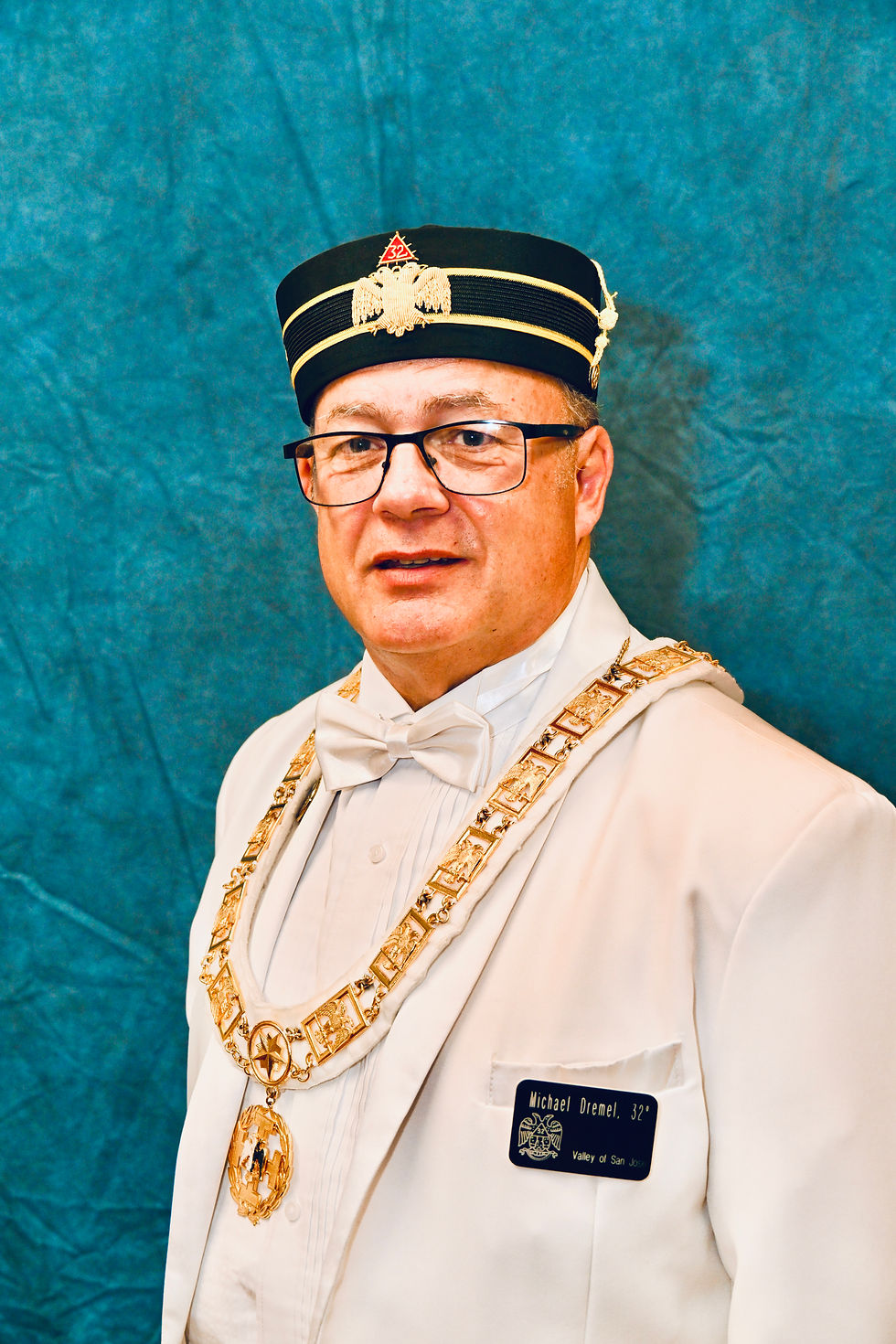
From the Commander of Kadosh (September 2026)
“Eripuit Caelo Fulmen, Sceptrumque Tyrannis”
By Michael Dremel
In France, circa 1780, the French naturalist Étienne François Turgot quipped:
“He snatched the lightning from the heavens and the scepter from tyrants.”
The phrase is a tribute to two key attributes of one of our most famous Founding Fathers, Benjamin Franklin.
Who else in history “tamed the lightning” with a kite and a key, contributing to our understanding of electricity, the lightning rod, and myriad other inventions, while in the same lifetime greatly aiding American independence by helping pull the scepter from King George III’s tyrannical hand, forever changing the world in which we live?
The duality of Franklin’s genius made him both an inventor and a statesman. His innovations included bifocals and numerous practical devices, while his ideas and diplomacy greatly influenced our nascent political landscape.
Franklin’s Early Years
Let us harken back to Franklin’s youth, when he was raised in a Puritanical atmosphere. At a mere 21 years of age, he started the Leather Apron Club, a group of young tradesmen limited to 20 members.
These inspired colonial minds met in Philadelphia to exchange ideas and encourage intellectual and moral improvement. Members embraced principles that included a love of humankind regardless of religion or profession, the pursuit of truth for its own sake, and freedom of speculative opinion, including the right to agree to disagree without fear of reprisal or exile.
Even before his involvement in Masonry, Franklin was developing ideas that reflected the principles of a universal brotherhood.
Benjamin Franklin the Mason
Franklin formally joined our institution in early 1731, when he was initiated into St. John’s Lodge in Philadelphia. He would subsequently be passed and raised and became deeply involved in Pennsylvania Masonry.
Only a few years later, Franklin served as Grand Master of Pennsylvania.
In 1734, he published the first Masonic book printed in America, a reprint of Anderson’s Constitutions of the Free-Masons. This was certainly a deliberate effort to help solidify the jurisprudence and foundation of rapidly growing American Freemasonry.
Franklin’s Masonic tenure initially owed allegiance to the “Moderns” of the Premier Grand Lodge. Another faction, known as the “Antients,” represented a fiercely independent tradition that would resonate strongly with portions of American Masonry.
Friction developed between these two factions. While Franklin was abroad procuring allies for the Revolution, the Antients grew in influence and eventually established the Masonic structure from which the Grand Lodge of Pennsylvania developed.
Despite the ideals of Enlightenment, divisions and animosity between the two traditions persisted for years.
Franklin and Freemasonry in France
Meanwhile, back in France, Franklin became associated with the celebrated Loge des Neuf Sœurs, or Lodge of the Nine Sisters, an important intellectual center of the Enlightenment.
The French populace revered Franklin. To many, he represented the rustic wisdom and republican ideals of the emerging American nation. His personal prestige, celebrity, intellect, and considerable social skills helped him secure vital French support for the American cause.
With French financial assistance, military support, and naval power, the prospects for American victory were greatly strengthened.
Franklin also participated in the initiation of the 84-year-old Voltaire into the fraternity. The event became one of the most celebrated Masonic moments of the Enlightenment.
Franklin himself would eventually be honored as a living embodiment of Enlightenment ideals. Yet, in a dramatic gesture, he reportedly placed honors bestowed upon him at the foot of Voltaire’s bust.
Symbolically, the torch of liberty was being passed from the philosophers of the European Enlightenment to the builders of the new American Republic.
A Brother Among Brothers
Franklin remained loyal to Blue Lodge Masonry, yet his Masonic associations extended considerably further. He was connected with several lodges and Masonic bodies during his years in France, reflecting his deep and enduring commitment to the fraternity.
Franklin was not a man inclined to boast about his many titles and honors. Yet, upon his return to the new Republic, at the consecration of the new Sublime Lodge of Perfection in Philadelphia in 1785, a toast was offered:
“That dignified Philosopher and Friend to Mankind, Brother Benjamin Franklin.”
It was a fitting tribute and a demonstration that practitioners of the higher degrees recognized and honored Franklin as a spiritual kinsman.
Benjamin Franklin did not merely write about the Light.
He captured it.
He used it against ignorance and tyranny, and he helped illuminate the architecture of a free nation.
May the spirit of this truly remarkable Brother among Brothers inspire us to make a positive impact upon our lodges and communities and, by degrees, elevate our fellow man and our country toward an age of true equality, equity, and justice for all posterity, as Brother Benjamin Franklin would have wanted Masons to do.
References
Samu, Michael (2026). Benjamin Franklin, the Perfected Ashlar of Liberty. Fraternal Review.
Larson, Edward (2020). Franklin & Washington: The Founding Fathers Partnership. HarperCollins Publishers, New York.
San Jose Council of Kadosh Michael Dremel, 32° 2024 Commander of Kadosh

From the Master of Kadosh (September 2026)
Greetings, and Welcome to the Beginning of Fall.
The Autumnal Equinox falls this year on September 22, marking the time of year when the number of hours of light and darkness are nearly equal. From this point, darkness grows each day until we reach the shortest day of the year and the beginning of the Winter Solstice.
Through these changing seasons, we see in nature the cycle of life. Ancient peoples knew and understood that within this annual cycle were lessons and mysteries from which humanity could learn and grow.
When we look at indigenous cultures, we see how central the Earth, the heavens, and the four cardinal directions were to their beliefs and traditions. The Summer and Winter Solstices, along with the Vernal and Autumnal Equinoxes, demonstrate through their changing measures of light and darkness that there is also an internal journey, an internal cycle, within each of us.
The Wheel of the Year
There have been countless harvest festivals throughout history and across nearly every culture.
The Wheel of the Year is a modern framework incorporating pagan imagery and traditions from a variety of older sources and cultures. Earlier pagan traditions observed solstices, equinoxes, and cross-quarter days, often giving them agricultural, seasonal, or astrological significance.
For agricultural societies, these were much more than symbolic occasions. They were markers by which people lived, determining the times for sowing and reaping and, quite literally, helping sustain the land and its people.
The sacred cosmology of many modern pagans views life in a cyclical manner, an endless progression of birth, life, death, and rebirth.
This cycle is represented by the eight points of the Wheel of the Year:
Yule: December 20–23
Imbolc: February 2
Ostara: March 19–23
Beltane: May 1
Midsummer: June 19–23
Lughnasadh: August 1
Mabon: September 21–24
Samhain: November 1
Mabon and the Autumnal Equinox
Mabon is a modern pagan celebration associated with the Autumnal Equinox and is sometimes known as Harvest Home. It marks a period within the harvest cycle when night and day stand in balance, a time when that which was sown is reaped and thanks are given to Mother Earth for the bounty provided.
In modern tradition, the name Mabon is associated with a figure from Welsh mythology, Mabon ap Modron, whose name means “Mabon, son of Modron.” Some historians dispute the idea that an ancient Celtic festival called Mabon ever existed, noting that the name became associated with the modern pagan celebration during the 20th century.
Symbols associated with Mabon include gourds, apples, dried seeds, pomegranates, pinecones, ivy vines, and horns of plenty. Herbs and plants associated with the season include roses, ferns, acorns, thistle, and honeysuckle.
The colors of red, gold, brown, maroon, and orange are also closely associated with this time of year. Farming implements and harvest symbols, including baskets, scythes, and hand trowels, further represent humanity's relationship with the Earth and the bounty of the harvest.
Light and Darkness
Throughout time and across cultures, we find a common recognition of the relationship between light and darkness.
The cycle of birth, life, death, and ultimately rebirth occurs not only in the world around us, but can also serve as a reflection of the cyclical patterns within each of us.
As the seasons change and light gives way to increasing darkness, perhaps we are reminded that both have their place. There is a time to sow and a time to reap, a time for outward labor and a time for inward reflection.
Fun, Fellowship, and Supporting RiteCare
This month, we are partnering with Rose Croix for an afternoon of fun and fellowship at Campo di Bocce on Saturday, September 26th at 1:00 PM.
There are only 24 openings available for those wishing to play on the court, although additional Brethren are welcome to join us to socialize and eat.
Please contact the General Secretary or me to sign up.
We will also be accepting donations from participants that day, with all donations benefiting the RiteCare Clinic.
Come out, play, eat, enjoy the fellowship, and help us make a difference for the clinic.
San Jose Consistory Brandon Dueñas, 32° KCCH 2025 Venerable Master of Kadosh

From the Chief Knight
(September 2026)
Greetings Brethren,
I am happy to announce that the Knights of Saint Andrew has two new members, Brothers Eddie Hermano and Kendrick Baker.
Welcome, my Brothers!
Our Most Worshipful Grand Master was quite impressed with the Arch of Steel that we conducted for his reception. Rumor has it that we were the only Valley to perform this honor for him at our July 14th reception.
And, of course, we also trooped the colors.
Thank you to each and every one of you who participated in these activities. Your dedication and willingness to serve are what make the Knights of Saint Andrew such a special part of our Valley.
Not to be repetitive, but our Highland Games Committee has reported that the Burlingame, Oakland, and Stockton Scottish Rite KSAs will be joining us at this event. We are still waiting to hear from the Sacramento, San Francisco, and Santa Rosa KSAs.
I hope to see many of you at our Hospitality Tent. If nothing else, it will give you a chance to sit down, get out of the sun, and relax with your Brethren while enjoying some fellowship.
Our next regularly scheduled meeting will be September 20th at High Twelve, in the classroom downstairs. All 29th Degree or higher Brothers are cordially invited to join us for some good fellowship.
If you have any questions about KSA, please feel free to contact me or any of my Officers.
We look forward to the privilege of serving our Brethren. San Jose Knights of St. Andrew Alan Porjesz, 32°
2026 Chief Knight, KSA
The Knights of Saint Andrew 2026 Officers
Chief Knight | Bro. Alan Porjesz 32º |
First Knight | Bro. Mike Lammer 32º |
Knight of the Watch | Bro. Ben Shuford 32º, PCK |
Secretary | Bro. Tim Lynch 32º |
Monk Knight | Bro. Chris Boyes 32º |
Sentinel | Bro. Maximo Mora 32º |
