
Voices of the Valley - October 2026

From the Venerable Master (October 2026)
In the Masonic family, there are a number of organizations dedicated to helping children. Most Masons are familiar with the Shriners and their support of Shriners Children’s. Another organization with a charitable mission benefiting children is Grottoes International, formally known as the Mystic Order of Veiled Prophets of the Enchanted Realm (MOVPER).
Grottoes International is a Masonic organization centered on fellowship, fun, and philanthropy. Its members are known as Prophets, rather than Brothers as in the Lodge or Companions as in the York Rite.
Prophets support the Grottoes International Humanitarian Foundation, whose primary mission is helping children with special needs receive essential dental care.
A Little Grotto History
The Mystic Order of Veiled Prophets of the Enchanted Realm, whose local bodies are called Grottoes, is an organization by and for Master Masons. Although it is not part of Symbolic Craft Masonry, membership is restricted exclusively to Master Masons in good standing.
The Grotto has always emphasized wholesome fun and fellowship while remaining grounded in Masonic values. Its traditional slogan is GOOD FELLOWSHIP.
For several years prior to 1889, members of Hamilton Lodge No. 120, F.&A.M., in Hamilton, New York, occasionally gathered informally to relax from the more serious duties of life and enjoy fun and fellowship.
One of the driving forces behind those gatherings was LeRoy Fairchild. On September 10, 1889, Fairchild and several fellow Masons held the first meeting of the organization that would eventually become Grottoes International. From the beginning, they determined that membership would be limited to Master Masons in good standing.
The Supreme Council of the Mystic Order of Veiled Prophets of the Enchanted Realm was formally established on June 13, 1890.
Helping Children with Special Needs
The Grottoes International Humanitarian Foundation is a 501(c)(3) nonprofit organization and the official charity of Grottoes International. It was created by the Supreme Council in 1949 to establish a national charitable program.
Today, its Dental Care for Children with Special Needs Program helps eligible children under the age of 21 obtain needed dental treatment. The Foundation works with qualified dental professionals throughout the United States and Canada and assists with dental treatment and anesthesia expenses.
The Enchanted Lantern
In the early days of the Grotto, members would hang a red railroad lantern in a window to identify the location of a meeting.
That tradition was not forgotten. In 1953, the Grottoes adopted the Enchanted Lantern as an emblem representing contributions of $50 or more to the Humanitarian Foundation.
Today, the Enchanted Lantern represents a “Beacon of Hope” for children with special needs, and the program continues to be an important source of support for the Foundation’s charitable work.
Who Leads Grottoes International?
The presiding officer of Grottoes International is known as the Grand Monarch.
For comparison, the highest elected office in Shriners International is the Imperial Potentate.
So, the next time you hear someone mention a Grotto, a Prophet, or the Enchanted Lantern, you will know a little more about this unique organization within the greater Masonic family.
Now you know.
San Jose Lodge of Perfection David Kampschafer, 32° KCCH 2024 Venerable Master

From the Wise Master
(October 2026)
Autumn Reflections in the Chapter of Rose Croix
As autumn arrives and the seasons begin to change, it offers Masons a natural opportunity for reflection, gratitude, balance, and renewal.
Although autumn does not carry a specific ritual observance within the Chapter of Rose Croix comparable to its traditional spring Ceremony of Remembrance and Renewal, the changing season provides meaningful symbolism that complements many of the lessons found throughout the Scottish Rite.
The Harvest of Character
Autumn has long been associated with harvest, the gathering of what has been cultivated through months of labor.
For a Mason, this can serve as an appropriate time to consider a different kind of harvest: the results of his own labor upon himself.
Have our actions reflected the principles we profess? Have we practiced justice, humility, charity, tolerance, and brotherly love? Have we continued the work of improving that spiritual and moral temple which every Mason is charged to build?
Just as the harvest reveals what was produced from the seeds planted earlier in the year, reflection allows us to consider what our own choices and efforts have produced.
A Return to Labor
For many Masonic bodies, autumn also means returning to regular activity following the summer months.
Valleys resume meetings, reunions, educational programs, degrees, charitable activities, and opportunities for fellowship. In this practical sense, autumn becomes not an ending, but a renewal of Masonic labor.
It is an opportunity to return with greater purpose, renewed enthusiasm, and a deeper appreciation for the fellowship that binds us together.
The Chapter of Rose Croix
In the Southern Jurisdiction of the Scottish Rite, the Chapter of Rose Croix encompasses the 15th through the 18th Degrees.
These degrees continue the Scottish Rite journey through lessons involving perseverance, restoration, faith, tolerance, service, sacrifice, and the responsibilities we owe to one another.
The 18th Degree, Knight Rose Croix, is particularly associated with themes of love, self-sacrifice, service to humanity, and the enduring bonds of fraternity.
These lessons lend themselves naturally to contemplation during a season when the world around us is changing.
Balance and Change
Autumn stands between the fullness of summer and the stillness of winter. Light diminishes, leaves change and fall, and nature enters another stage in its continual cycle.
For the reflective Mason, these changes can symbolize the importance of balance and perspective.
There is a time to labor and a time to reflect. A time to sow and a time to reap. A time to celebrate accomplishment and a time to consider what remains unfinished.
The changing season reminds us that progress is not always measured by outward activity. Sometimes growth comes through contemplation, study, gratitude, and an honest examination of ourselves.
Remembrance and Renewal
The Chapter of Rose Croix also has a special tradition centered upon remembrance.
The Ceremony of Remembrance and Renewal, historically connected with Maundy Thursday observances, is now traditionally held near the vernal equinox in the spring. It commemorates departed Brethren while emphasizing fraternal love, service, renewal, and the enduring bonds of Masonry.
While that ceremony belongs to another season, its lessons need not be confined to a particular date on the calendar.
Autumn can likewise remind us of those who came before us, the lessons they left behind, and our responsibility to continue the work entrusted to us.
A Season for Reflection
As the year moves toward its final months, autumn gives us an opportunity to consider not only what we have accomplished, but what kind of men we have become through the labor.
The leaves will fall and the seasons will change, but the work of building character continues.
For the Scottish Rite Mason, perhaps that is autumn's most useful lesson: to reflect upon the harvest of our labors, renew our commitment to the principles of the Craft, and prepare ourselves for the work still ahead.
San Jose Chapter of Rose Croix Frank Fitzgerald, 32° KCCH 2024 Wise Master
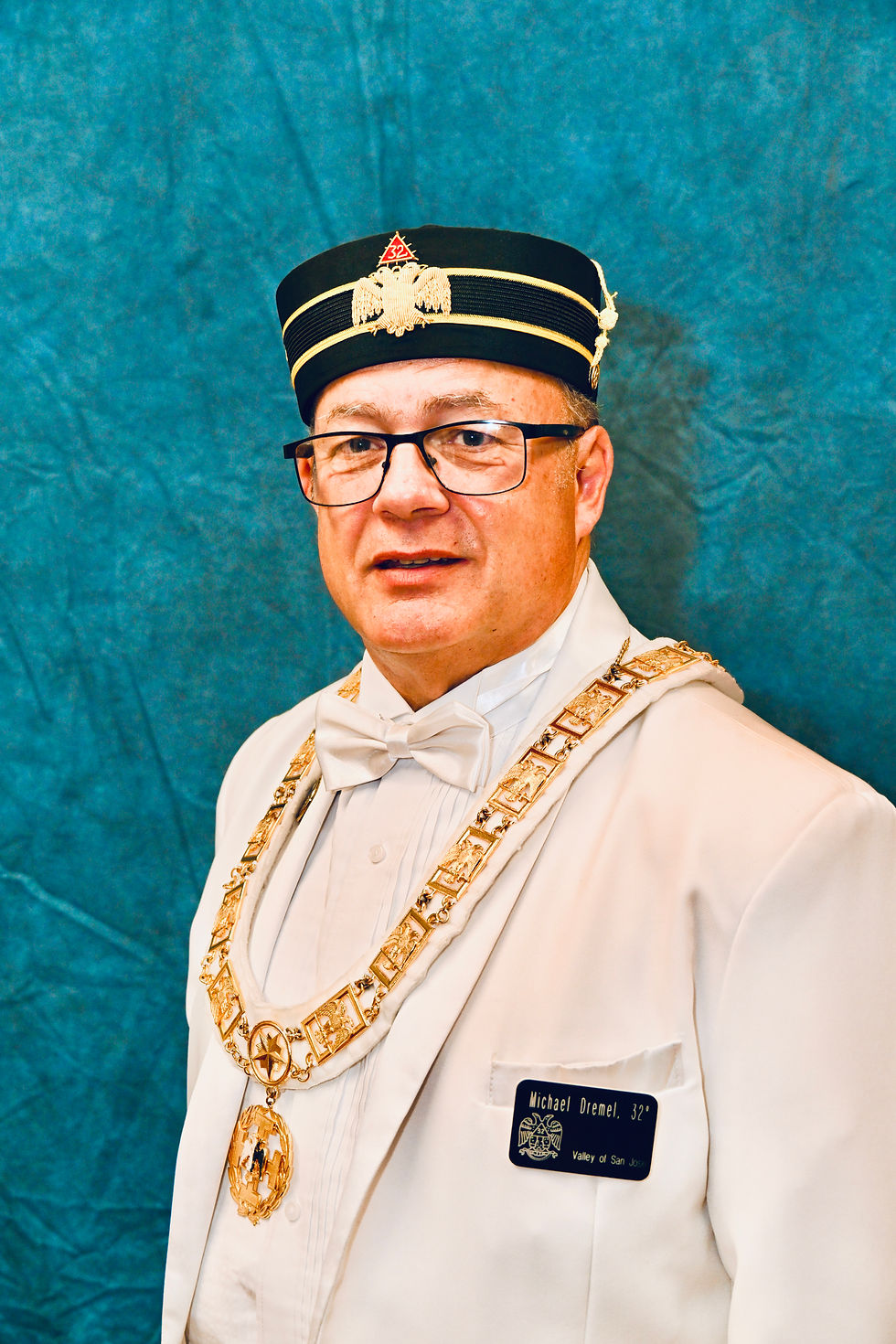
From the Commander of Kadosh (October 2026)
At the Will and Pleasure of the Worshipful Master: Authority, Trust and the Limits of the East
By Michael J, Dremel, Commander of Kadosh
There is an old phrase in Masonry that can sound rather startling when first encountered: “At the will and pleasure of the Worshipful Master.”
I confess that I have contemplated considerably about those words even before taking my place in the East. Read literally, they can sound almost tyrannical – as though the Worshipful Master may simply command whatever pleases him and the brethren are expected to comply. Frankly I’ve encountered or witnessed such paradigms in various lodges at different times. In reality, however, a Worshipful Master remains subject to Grand Lodge law, the Constitution and regulations, the Bylaws of his Lodge, the ancient usages and customs of Masonry, his obligations and the rights of the brethren.
But there is danger in going too far in the opposite direction.
Given the possibility of an autocratic Master taking power, a lodge might surround the chair with so many informal restrictions, permissions, precedents, and expectations that the Master only possesses the title while others informally exercise the authority.
That cannot be right either!
The lodge brethren elect a Master and place him in the East for a reason. They entrust him with substantial authority because someone must ultimately be responsible for governing the Lodge, preserving order, setting its direction, and protecting its harmony. Authority and responsibility must travel hand in hand. It is unreasonable to hold a Master accountable for the condition of the lodge while denying him the authority necessary to govern it.
Hence I have come to understand the will and pleasure axiom somewhat differently. It does not mean “whatever pleases the Master”. It means that within those matters legitimately entrusted to the office, the Master MUST be allowed to master his lodge. In other words, to lead it unencumbered by those PMs who knowingly or unknowingly try to exercise the chair’s power and authority.
This distinction matters, as the authority belongs to the office, not permanently to the brother occupying it. Perhaps nowhere does that become more apparent than when a Worshipful Master becomes a Past Master. Admittedly, to some, leaving the East can be difficult, especially if they’ve held that possible for 2-3 years. They immediately must and very consciously make that change themselves.
A brother who has spent a year or three making decisions, giving instructions, and planning programs, does not instantly lose those habits when his successor is installed. A recent Past Master may still internally or outwardly say “Let’s do it THIS way” or “I want this done NOW” or speak for the Lodge as though decisions remain his to make.
Usually, I suspect that there likely was no malicious intent. He may simply still be speaking with the voice and verbiage he became accustomed to using while sitting in the East. The new Master may find himself reluctant to contradict a respected predecessor, so lodge brethren may continue looking to the Past Master. The PM may openly contradict the Worshipful Master or diminish his authority by speaking out. Ergo the PM commits harm to the lodge by generating a toxic environment, where authority becomes uncertain – not because anyone deliberately seized it, but because someone forgot or lacked the Masonic integrity to really and fully relinquish it.
There is an important lesson there for every man who occupies the East.
The authority remains in the East. The man does not take it with him when he leaves the chair. In the military, when a new commander arrives to take command, the former commander’s flag (the symbol of authority) is ceremoniously presented to the incoming commander. At that moment, the former commander and his family are quickly and immediately whisked away, with no further contact with their former unit. That’s the NEW commander’s prerogative, and the flag in her or his hands reminds everyone that she or he is now in charge and enjoys full authority.
In similar manner, one of the finest services a Past Master can render his Lodge may be knowing when NOT to exercise influence or even be present when the Master needs to be able to exercise his authority freely. Surely, the PM possesses experience and institutional memory. He has undoubtedly made mistakes from which his successor can benefit. I haven’t met a PM yet who would not share a piece of wisdom with a Worshipful Master when asked.
However, his wise counsel, even sincerely given, is not a command.
A Past Master should strengthen the authority of the sitting Master, not compete with it. Sometimes that means offering advice privately and certainly sparingly. Sometimes it means supporting a decision he himself would not have made. An old axiom states if a PM speaks more than the Master, odds are the PM is talking WAY too much, possibly endangering the authority in the East inadvertently vice supporting it. As a duty to the lodge, a loyal PM should strive to help the Worshipful Master to maintain and even enhance harmony and peace within it!
A Worshipful Master may pound the gavel to bring order, but as the saying goes, “The gavel can produce silence, but not harmony.”
True authority in a Masonic Lodge is strongest when exercised calmly, lawfully, consistently and sparingly. The Master can listen to his officers. He should seek the wisdom of his Past Masters. He should encourage a difference in opinion when offered respectfully and in the proper manner. He should remember that every brother sitting before him is his Masonic equal even though, for a season, he has been entrusted with governing the Lodge.
But after all the talk and listening is over, there will come a moment when he as Worshipful Master must decide.
That is why there is an East.
Perhaps, then, “at the will and pleasure of the Worshipful Master” is not a declaration of privilege at all, but a declaration of responsibility. For a brief period, the brethren place one of their own in the East and entrust him with something precious: authority over a lodge that existed before him and, God willing, will exist long after him. He must neither abuse nor surrender it. He must exercise it judiciously.
When his year is completed, there is one final act of Mastery duty yet to perform: He must figuratively surrender the gavel and allow that elected brother to discover for himself both the burden and the privilege of leadership in his lodge.
Thus, the lodge’s peace and harmony are strengthened right from start for the new Man sitting in that august chair!
San Jose Council of Kadosh Michael Dremel, 32° 2024 Commander of Kadosh

From the Master of Kadosh (October 2026)
Greetings, and welcome to the month of October. This is the tenth month of the year according to the Gregorian and Julian calendars, however this was not always so. In the context of the original Roman republican calendar (750 BC), October was the eighth month. The Roman calendar consisted of only ten months including : Martius, Aprilis, Maius, Junius, Quintilis, Sextilis, September, October, November, and December. January and February were added to complete our twelve month calendar in 450 BC. This eighth month’s name stems from Latin and Greek ôctō / οκτώ meaning eight, and the later Middle English Octobre.
The month of October has the astrological sign of Libra, and holds the seventh place in the astrological sky. Libra’s footprint above covers 180°–210° of celestial longitude. Libra is represented by the scales. We see this represented in the Greek goddess Themis holding the scales of justice while she herself symbolizes wisdom, good council, and divine law. Libra is the only zodiac sign represented by a non living animal/mythological creature being the scales.
A couple notable events are celebrated this month, and one of which is Sukkot(Oct 9-16th). Sukkot (סוכות) is a major Jewish holiday and the last of the Shalosh R'galim (three major pilgrimage festivals). Sukkah (Hebrew) means huts/booths, and stems from the Autumnal festival hag ha-asif when they were used for the celebration of the harvest. The three sided structure is covered with branches/thatch so that the sun may be blocked, but also to allow for the starry night to be viewed. This harvest time celebration commemorates the holy land, in part by four species of plants.
“And ye shall take you on the first day the boughs of goodly trees, branches of palm trees, and the boughs of thick trees, and willows of the brook; and ye shall rejoice before the Lord your God seven days.”(Leviticus 23:40 KJV).
Arba Minim translated from Hebrew means ‘four species’. The four are thus classed: etrog (a small citrus fruit in english called a citron), two willow branches (aravot), three myrtle branches (hadassim), and a palm branch (lulav). When these six are bound, the order is left to right : willow, palm, and myrtle. When bound together, it is collectively called the Lulav, and is waved in all four of the cardinal directions, with the addition of above and below signifying the presence of God being all around. This joyous holiday also holds the memory of the vulnerability in which the Israelites used these portable homes in the desert which they wandered for those 40 years while relying on the Great Architect.
Another holiday this month is Samhain (samain in ancient Celtic religion), and is a major part of the Wheel of the Year. This being the last and the most important of the fire festivals, marks the time of the year when the world of the gods may be viewed by man, when the veil is thinnest, and tricks are played on their mortal worshipers. Ancestors’ past are honored and welcomed home whilst evil ones are warded off, while wearing masks along with costumes to hide from evil and harm. Food is prepared not just for the living, but also for those ancestors’ past, with a portion being ritualy shared with the less fortunate ones.
This several day holiday likely predates the Celts of 2,500 years ago, and is evident at the Tara location. The Mound of Hostages on the hill of Tara where the Celts celebrated Samhain has an entrance which aligns with morning rays of the holiday, and shows the celebration dating 4,500 to 5,00 years ago. We see the cauldron as a symbol associated with this holiday depicting the feminine and cosmic container for all life, death, transformation, and rebirth.
The besom (broom) has a twofold purpose, the first sweeping the physical autumn leaves from one's home, and also to sweep and cleanse the evil from a space. These besom are traditionally constructed with birch twigs, bound to purification and renewal. The mighty acorn is another item associated with this time of year and holiday, by its potential to become the great mighty oak. The oak represents wisdom, longevity, and rebirth; while an acorn in your pocket may be an amulet of good fortune to come.
The colors for this holiday are black, orange, and purple. The black to signify death, and the ending of things. The orange shows that vitality that exists of life within death. Purple gives the meaning of wisdom, inspiration, and insight.
These two decidedly different holidays, from two very different traditions, are celebrations of life, harvest and death, making the month of October a month of reaping and celebration. The commonality of themes in these opposite faiths is central to the study of comparative religion, intertwined within our Scottish Rite ritual.
San Jose Consistory Brandon Dueñas, 32° KCCH 2025 Venerable Master of Kadosh

From the Chief Knight
(October 2026)
Greetings Brethren,
Well, it finally happened, Labor Day Weekend and the Highland Games. What a wonderful weekend. The weather was perfect and so was our new location which was really our old location of a few years ago.
We were located near the Food Court and the Bag Pipe Competition so there was a lot of foot traffic for people to see our Hospitality Tent. I wish to thank all the KSA Scottish Rite Valleys that showed up to help man our tent. We had Masons from far and wide away. I met one Brother from Saint Paul, Minnesota; now that’s what I call dedication to the Craft.
A special Thank You to Past Chief Knights Mike Lammer and Jeff Tome for doing a first-rate job of getting our equipment and refreshments up to the fair grounds and setting up the tents on Friday. Then striking our equipment on Sunday with the help of Sue and Tommy Tefft and getting it back to San Jose.
I would like to take the opportunity to congratulate Knight of the First Order Angelo Encarnacion on receiving his Hiram Award on October 3rd.
Our next regularly scheduled meeting will be October 18th, High 12, in the classroom downstairs. All 29th Degree or higher Brothers are cordially invited to join us for some good fellowship.
If you have any questions about KSA please feel free to contact me or any of my Officers. We look forward to the privilege of serving our brethren. San Jose Knights of St. Andrew Alan Porjesz, 32°
2026 Chief Knight, KSA
The Knights of Saint Andrew 2026 Officers
Chief Knight | Bro. Alan Porjesz 32º |
First Knight | Bro. Mike Lammer 32º |
Knight of the Watch | Bro. Ben Shuford 32º, PCK |
Secretary | Bro. Tim Lynch 32º |
Monk Knight | Bro. Chris Boyes 32º |
Sentinel | Bro. Maximo Mora 32º |
