
Voices of the Valley - August 2026

From the Venerable Master (August 2026)
Brother Harry S. Truman
While serving as President of the United States, Brother Harry S. Truman remained an active Mason. On one occasion, he attended a Masonic meeting accompanied, as required, by a Secret Service agent.
As Truman approached the lodge room, the agent moved to follow him inside.
Truman stopped.
He turned to the agent and said, calmly but firmly:
“You can’t come in there with me.”
The agent explained that his duty was to protect the President at all times. He was armed. He was responsible for the President’s safety. He could stand quietly in the back.
Truman shook his head.
“Inside that room, I am not the President.And you are not my guard.In there, all men meet on the level.”
He instructed the agent to wait outside.
The meeting proceeded as any other lodge meeting would. Truman sat not as Commander in Chief, but as a Brother, under the same obligations, governed by the same rules, and bound by the same trust as every man present.
Brethren, that moment tells us something essential.
Truman understood that the lodge room is one of the few places in the world where rank is checked at the door. No office outranks obligation. No authority overrides equality. Even the most powerful man in the nation does not stand above the Craft.
What is even more remarkable is this:
Truman did not view that restriction as a risk.
He viewed it as a sacred boundary.
The trust he placed in the lodge was greater than the fear he carried from the outside world.
That is faith in Masonry.
It also reminds us of our responsibility. If a President could lay aside power, protection, and title to sit among Brothers as an equal, then the sanctity of this room depends upon us honoring that same trust.
So the lesson here is not simply about Harry Truman being humble.
It is about Harry Truman being obedient to his obligation.
The lodge room remains special only as long as we protect what it represents:
Equality over status
Trust over fear
Brotherhood over authority
Brethren, when we enter the lodge room, we all leave something behind.
For Truman, it was the Presidency.
For us, it should be our pride.
San Jose Lodge of Perfection David Kampschafer, 32° KCCH 2024 Venerable Master

From the Wise Master
(August 2026)
Brethren of My Valley,
Summer is a time for travel, and as stated so well in the Scottish Rite Journal, “I suggest you travel with ice cream.” Please reference the Grand Commander’s message on “ice cream cones” while traveling to faraway places.
I especially enjoyed his message about visiting Charleston, South Carolina, and the French Quarter for the 225th anniversary. The French played an important role in the development of the Scottish Rite degrees in the Southern District of the United States. At Shepheard’s Tavern, I believe, members gathered near the corner of Broad and Church Streets and helped establish what would become the Scottish Rite, Southern Jurisdiction, in the United States of America.
As a true traveler, I write to you this month from within the Aurelian Walls of Rome, Italy, built by Emperor Aurelian between A.D. 271 and 275 to protect the city.
The ice cream here is quite different, of course. It is called gelato.
Travel is extremely important to understanding the history of Masonry and the work of the operative masons who came before us. Structures built in the Eternal City have been studied for centuries and remain standing today. Construction engineers continue to marvel at the mathematics, geometry, engineering, and craftsmanship behind structures such as the Pantheon. Even today, some of the techniques used by the operative masons and builders of ancient Rome, particularly their methods of working with concrete, are not fully understood.
The name Pantheon is derived from the Greek and is commonly interpreted to mean “all gods.” The original Pantheon was built around 27 B.C., with the present structure dating to the reign of Emperor Hadrian in the second century A.D.
The Pantheon’s rotunda is a remarkable achievement of geometry. Its interior height is approximately equal to its diameter, meaning that a perfect sphere could fit within the interior space.
At the center of its massive dome is the oculus, an opening that allows sunlight directly into the building and once allowed smoke to escape. Because the oculus remains open to the sky, when it rains outside, it also rains inside.
The remarkable marble floor was designed with a slight slope that directs rainwater toward nearly invisible drains. It is yet another example of the extraordinary planning, mathematics, and craftsmanship of the ancient builders.
The Pantheon remains one of the most visited and best-preserved monuments of ancient Rome, standing as a testament to the knowledge and skill of the builders who came before us.
San Jose Chapter of Rose Croix Frank Fitzgerald, 32° KCCH 2024 Wise Master
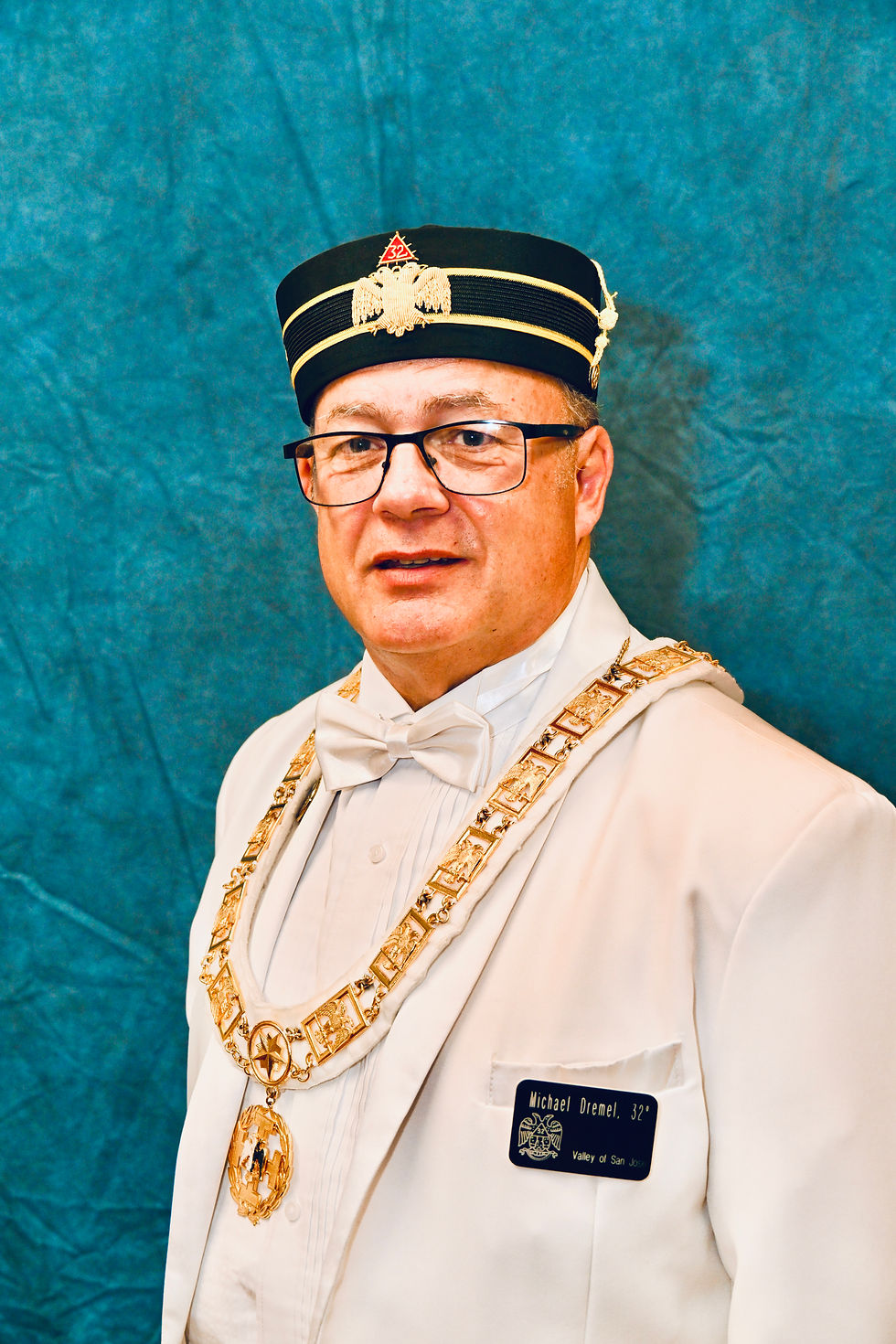
From the Commander of Kadosh (August 2026)
Speculative in Spirit, Operative in Practice
By Brother Michael Dremel
Though not spoken often these days, recall the old saying that time is fleeting, and today’s news is tomorrow’s history. In the history of our beloved fraternity, we have moved through our own various phases, from periods of egregious lulls to inspirational progress. Through each of these periods, new vocabularies sprang up, some of which are still with us, while others long ago faded into oblivion.
Such is the natural passage of time, but recently I became intrigued by the transition from the use of the words “operative” versus “speculative” Masons.
Obviously, the operative adjective has been around quite a long time, at least since stonemasons were physically building the great cathedrals and other structures that required unique and specific skill sets. The use of the square, compasses, and level was practiced as part of their craft.
Speculative Masons did not necessarily possess the skills to build planned architecture, as they were often merchants, local businessmen, and men involved in government. At some point, as the demand for skilled stonecutters fell, their guilds began to teach and practice the symbolic meanings of their ancient tools and principles.
This group was still bound by the Old Charges, a set of codes rich in practical stonework rules, moral obligations, and guild regulations. In addition to learning the first stirrings of early Masonic philosophy, these groups also taught the emerging principles of speculative Masonry, using the same operative symbols, rules, and rituals as metaphors for spiritual and personal development.
During the period between the Operative Masons, who practiced the craft side of Masonic lore, and the Speculative Masons, who adhered to its philosophical side, there was a transitional phase. This caused Masons to engage with both sides, or at least with some elements of each.
As the number of skilled workers and experts declined, many operative Masons began to teach and practice the symbolic meanings of their tools and their speculative interpretations. This led to the formal emergence of speculative practice as a permanent fixture in Masonry, using the symbolic meanings of the Mason’s tools and principles.
Likely during this transition period, when Speculative Masonry truly began to take hold and grow, Masons were neither fully operative builders nor fully speculative philosophers. Such Masons were sometimes referred to as “Theoretical Masons,” “Gentlemen Masons,” or simply “Honorary Members.”
These unique members might still have been employed as operative Masons, but they also spent time studying, and later teaching, the symbolic meanings and nuances of Masonic tools and principles. They might attend operative lodges while also participating in rituals and philosophical discussions.
A phrase began to be used at higher-level guilds and lodges:
“Spiritu speculativius, sed in praxi operativus.”“Speculative in Spirit, Operative in Practice.”
This likely emphasized that the skilled artisan, citizen, or Speculative Mason could explain the deeper meanings of the Craft. These men became preservers of the Craft.
For example, early minutes from 1631 record the introduction of “gentlemen Masons” and “theoretical Masons” alongside operative members. From these minutes and records of building activity in large cities, we can theorize that speculative Masonry began to take hold during the 17th century.
In essence, the group existing between Speculative and Operative Masonry represented a de facto hybrid category of Masons who retained operative skills while also engaging with the symbolic and philosophical dimensions of the Craft. They served as a bridge between the physical builder and the moral teacher.
Gradually, as time passed, operative lodges fully welcomed this new breed, eventually naming them “Accepted Masons,” well-educated men from outside the trades who were drawn to the allure of Masonic symbolism.
Their acceptance also created a demand for new Masonic constitutions, ones less concerned with the practical application of the stonemason’s tools and increasingly concerned with the nourishment of the human spirit.
Who could have foreseen that medieval guild statutes and the Old Charges would someday evolve into the philosophical teachings that we continue to study today?
Bibliography
Francon-macon.net, “Everything You Need to Know About Masonry” (2025)
From Operative Masonry to Speculative Constitutions (2025)
Transition from Operative to Speculative Masonry (2024)
San Jose Council of Kadosh Michael Dremel, 32° 2024 Commander of Kadosh

From the Master of Kadosh (August 2026)
Greetings, as we welcome in August.
August is derived from the Latin Augustus, meaning “consecrated” or “venerable.” In discussing the month, religion, and degrees recently, Sufism came up. Seeing the ties to our Craft, I wanted to share a bit about them and us.
Sofis, or Sufis, are members of a mystical tradition that prevailed in the eastern portion of the world, particularly in Persia. The name was most likely derived from the Greek σοφία, meaning “wisdom.” The foremost writers were familiar with Aristotle and Plato, and their paramount works were filled with references to Plato.
There are four degrees or stages during initiation. Through these four stages, the study of rites, ceremonies, religions, and spiritual worship encompasses the first two. The third degree, Wisdom, makes one equal to angels and grants supernatural powers. In the fourth and final degree, Truth, one becomes united with Deity.
Let us look at how this group ties to the Scottish Rite, and ultimately, to all of us.
The 25th Degree: Sufi Master / Knight of the Brazen Serpent
The Sufi Master is one who has mastered himself through learning. We find that regardless of the amount of knowledge we consume, there is a lack of fulfillment without the WORD or without teaching others.
Ultimately, it is our duty to extend our truths to the world as we understand them. As a republic of free men and freethinkers, we must leave our truth open to agreement, disparagement, further questioning, debate, or even absolute destruction by the mob. It is not our place to press our truths upon others.
As stated in Morals and Dogma:
“A serpent-ring was a well-known symbol of time: and to express dramatically how time preys upon itself.”
Similarly, the Scottish Rite Monitor states:
“To us the Brazen Serpent, Nakhas, is a symbol of the wise interpretation which rescues the Divine Truths from the deprivation which they have undergone by means of the ignorance of many interpreters.”
The great Ouroboros will someday be no more, as will all living beings, and even the stars.
The Tau, Tau cross, or Tau mark was a universal sacred symbol among the ancients. It is known that the Tau existed before many of today’s major religions and appeared throughout the ancient world.
In Christianity, the cross of the Old Testament is sometimes called the anticipatory cross. It was the mark upon the forehead of Aaron when Moses anointed him. This sign saved the young Isaac from death and saved a nation that looked upon the brass serpent on the staff containing the Tau marking.
The Egyptian Tau had an oval ring or handle atop it and was called the crux ansata, more commonly known today as the ankh, and was used as a symbol of life.
Dr. Clarke spoke of the Tau cross as a monogram of Thoth, “the symbolical or mystical name of hidden wisdom among the ancient Egyptians.”
Again, wisdom and faith equate to tolerance.
Through these concepts, mankind has continually sought to make sense of the world around him. Finally, the words Holatai, a form of ground mana, suggest that our teachings of truth, when joined with tolerance and faith and accepted as such by even one other person, can yield compassion and love, that divine spark within us all.
“Don’t you know that you are the temple of God, and the spirit of God resides in you?”1 Corinthians 3:16
Have an amazing month, and I will see you at our stated meeting.
San Jose Consistory Brandon Dueñas, 32° KCCH 2025 Venerable Master of Kadosh

From the Chief Knight
(August 2026)
Greetings Brethren,
To paraphrase one of our Most Worshipful Past Grand Masters, “What a wonderful time to be a Mason.”
On July 14th, we at the San Jose Scottish Rite hosted the Grand Master’s Reception, and it was well attended. The Knights of Saint Andrew performed both the Arch of Steel and the Color Guard.
I wish to thank all the members of KSA who took part in these activities. We mustered a 10-man Arch of Steel, plus a Leader, making this the largest Arch of Steel we have ever performed.
Our Highland Games Committee has reported that the Burlingame, Oakland, and Stockton Scottish Rite KSAs will be joining us for this event. We are still waiting to hear from the Sacramento, San Francisco, and Santa Rosa KSAs.
Again, I invite you all to reserve Labor Day Weekend, September 5th and 6th, for this event at the Alameda County Fairgrounds in Pleasanton. It is probably this area’s largest non-Masonic Masonic event.
I have it on good authority that we will have a premier location for our booth near the bagpipe competition. So, if you like bagpipes, KSA is the place to be!
Our next regularly scheduled meeting will be August 16th at High Twelve, in the classroom downstairs. All Brothers of the 29th Degree or higher are invited to join us for some good fellowship.
If you have any questions about KSA, please feel free to contact me or any of my Officers.
We look forward to the privilege of serving our Brethren. San Jose Knights of St. Andrew Alan Porjesz, 32°
2026 Chief Knight, KSA
The Knights of Saint Andrew 2026 Officers
Chief Knight | Bro. Alan Porjesz 32º |
First Knight | Bro. Mike Lammer 32º |
Knight of the Watch | Bro. Ben Shuford 32º, PCK |
Secretary | Bro. Tim Lynch 32º |
Monk Knight | Bro. Chris Boyes 32º |
Sentinel | Bro. Maximo Mora 32º |
